Transcribed
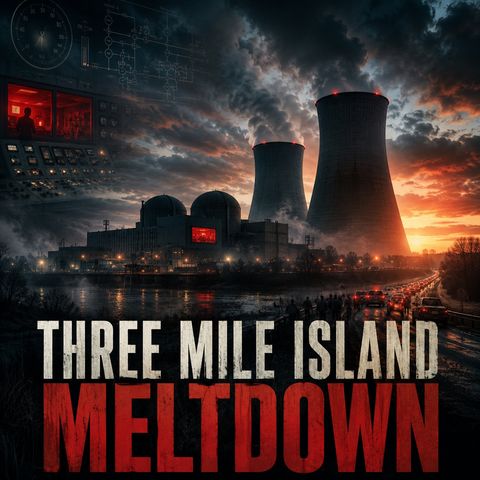
Three Mile Island Meltdown
Aug 30, 2026 ·
1h 33m
Download and listen anywhere
Download your favorite episodes and enjoy them, wherever you are! Sign up or log in now to access offline listening.
Three Mile Island Meltdown
This automatic transcript is brought to you by
Sounder.AI
This is an automatically generated transcript. Please note that complete accuracy is not guaranteed.
Description
On March 28, 1979, at 4:00 a.m., a relief valve at Three Mile Island opened as designed—and then failed to close. For more than two hours, operators believed it had...
show more
On March 28, 1979, at 4:00 a.m., a relief valve at Three Mile Island opened as designed—and then failed to close. For more than two hours, operators believed it had shut because the control-room indicator showed the electrical command, not the valve’s actual position.
By the time the mistake was understood, roughly half the fuel in Unit Two had melted.The men in the control room did not know how bad it was. Neither did the Nuclear Regulatory Commission. The full extent of the damage would not be confirmed until engineers lowered a camera into the reactor vessel three years later and found a five-foot void where the top of the core had once been.
In this episode of Disturbing History, Brian goes beyond the familiar story of America’s worst commercial nuclear accident and into the warnings, failures and unanswered questions that came before and after it.Eighteen months before the meltdown, another Babcock & Wilcox reactor at Davis-Besse experienced a nearly identical stuck-open relief valve. Engineers warned that operators could misread the signs of a loss-of-coolant accident and shut down emergency cooling at exactly the wrong moment. One NRC inspector was concerned enough to travel to Washington on his own time just six days before Three Mile Island to warn commissioners that something was badly wrong.
The Kemeny Commission later concluded that the correct operating guidance was never passed along to the utilities.The episode reconstructs the accident minute by minute: the closed emergency feedwater valves, the overwhelming alarm system, the printer that fell so far behind that critical records were lost, temperature readings above 2,000 degrees Fahrenheit that operators dismissed as impossible, and a hydrogen burn inside containment that was initially written off as an instrument problem.
Then the crisis moved beyond the plant.
Conflicting radiation readings, contradictory public statements and confusion inside state and federal agencies turned Three Mile Island into a communications disaster. Governor Dick Thornburgh advised pregnant women and young children within five miles of the plant to leave. Roughly 144,000 people ultimately evacuated the surrounding area.
The episode also examines the infamous hydrogen bubble, the federal scramble to obtain potassium iodide because no national stockpile existed, and the radiation readings that appeared, disappeared or were later disputed. And then there was the criminal investigation.Less than two months after the accident, control-room operator Harold Hartman told federal investigators that Metropolitan Edison had been falsifying reactor coolant leak-rate data before the meltdown to avoid shutting the plant down for repairs.
Federal prosecutors later sharply criticized the NRC’s handling of the allegations. In 1983, a grand jury indicted Metropolitan Edison on charges involving falsified tests and destroyed records. The company eventually pleaded guilty, becoming the only American nuclear utility convicted of a criminal offense.
The final portion of the episode turns to the question that remains the most controversial: what happened to the people living around the plant?
Residents reported metallic tastes, skin irritation, nausea, hair loss and dead animals. Official estimates said offsite radiation doses were far too low to cause acute radiation sickness. Decades of epidemiological studies have produced conflicting interpretations, with some finding no convincing cancer link and others identifying patterns that warranted further investigation.
Thousands of personal injury claims were eventually dismissed because plaintiffs could not prove exposure above the required legal threshold.Nearly half a century later, the physical story of Three Mile Island still is not finished. Much of the damaged core remains stored in Idaho, some radioactive material is still being removed from Unit Two, and the neighboring Unit One reactor is being prepared for a possible return to service as the Crane Clean Energy Center.
After thousands of pages of federal reports, a criminal prosecution, decades of litigation and the dismantling of a melted reactor core, some of the most basic questions surrounding Three Mile Island remain unresolved—including who closed two critical valves that should have been open on the morning the accident began.
Email Brian
Join Our FREE Newsletter
Get Brian's Books
Leave Us A Voicemail
Visit Our Website
Have a forgotten historical mystery, disturbing event, unsolved crime, or hidden conspiracy you think deserves investigation?
Send your suggestions to brian@paranormalworldproductions.com.
Disturbing History is a dark history podcast exploring unsolved mysteries, secret societies, historical conspiracies, lost civilizations, and the shadowy stories buried beneath the surface of the past.
Follow the show and enable automatic downloads so you never miss a deep dive into history’s most unsettling secrets.
Because sometimes the truth is darker than fiction.
show less
By the time the mistake was understood, roughly half the fuel in Unit Two had melted.The men in the control room did not know how bad it was. Neither did the Nuclear Regulatory Commission. The full extent of the damage would not be confirmed until engineers lowered a camera into the reactor vessel three years later and found a five-foot void where the top of the core had once been.
In this episode of Disturbing History, Brian goes beyond the familiar story of America’s worst commercial nuclear accident and into the warnings, failures and unanswered questions that came before and after it.Eighteen months before the meltdown, another Babcock & Wilcox reactor at Davis-Besse experienced a nearly identical stuck-open relief valve. Engineers warned that operators could misread the signs of a loss-of-coolant accident and shut down emergency cooling at exactly the wrong moment. One NRC inspector was concerned enough to travel to Washington on his own time just six days before Three Mile Island to warn commissioners that something was badly wrong.
The Kemeny Commission later concluded that the correct operating guidance was never passed along to the utilities.The episode reconstructs the accident minute by minute: the closed emergency feedwater valves, the overwhelming alarm system, the printer that fell so far behind that critical records were lost, temperature readings above 2,000 degrees Fahrenheit that operators dismissed as impossible, and a hydrogen burn inside containment that was initially written off as an instrument problem.
Then the crisis moved beyond the plant.
Conflicting radiation readings, contradictory public statements and confusion inside state and federal agencies turned Three Mile Island into a communications disaster. Governor Dick Thornburgh advised pregnant women and young children within five miles of the plant to leave. Roughly 144,000 people ultimately evacuated the surrounding area.
The episode also examines the infamous hydrogen bubble, the federal scramble to obtain potassium iodide because no national stockpile existed, and the radiation readings that appeared, disappeared or were later disputed. And then there was the criminal investigation.Less than two months after the accident, control-room operator Harold Hartman told federal investigators that Metropolitan Edison had been falsifying reactor coolant leak-rate data before the meltdown to avoid shutting the plant down for repairs.
Federal prosecutors later sharply criticized the NRC’s handling of the allegations. In 1983, a grand jury indicted Metropolitan Edison on charges involving falsified tests and destroyed records. The company eventually pleaded guilty, becoming the only American nuclear utility convicted of a criminal offense.
The final portion of the episode turns to the question that remains the most controversial: what happened to the people living around the plant?
Residents reported metallic tastes, skin irritation, nausea, hair loss and dead animals. Official estimates said offsite radiation doses were far too low to cause acute radiation sickness. Decades of epidemiological studies have produced conflicting interpretations, with some finding no convincing cancer link and others identifying patterns that warranted further investigation.
Thousands of personal injury claims were eventually dismissed because plaintiffs could not prove exposure above the required legal threshold.Nearly half a century later, the physical story of Three Mile Island still is not finished. Much of the damaged core remains stored in Idaho, some radioactive material is still being removed from Unit Two, and the neighboring Unit One reactor is being prepared for a possible return to service as the Crane Clean Energy Center.
After thousands of pages of federal reports, a criminal prosecution, decades of litigation and the dismantling of a melted reactor core, some of the most basic questions surrounding Three Mile Island remain unresolved—including who closed two critical valves that should have been open on the morning the accident began.
Email Brian
Join Our FREE Newsletter
Get Brian's Books
Leave Us A Voicemail
Visit Our Website
Have a forgotten historical mystery, disturbing event, unsolved crime, or hidden conspiracy you think deserves investigation?
Send your suggestions to brian@paranormalworldproductions.com.
Disturbing History is a dark history podcast exploring unsolved mysteries, secret societies, historical conspiracies, lost civilizations, and the shadowy stories buried beneath the surface of the past.
Follow the show and enable automatic downloads so you never miss a deep dive into history’s most unsettling secrets.
Because sometimes the truth is darker than fiction.
Information
| Author | Paranormal World Productions |
| Organization | Sasquatch Odyssey |
| Website | - |
| Tags |

Copyright 2026 - Spreaker Inc. an iHeartMedia Company

Comments