Contacts
Info
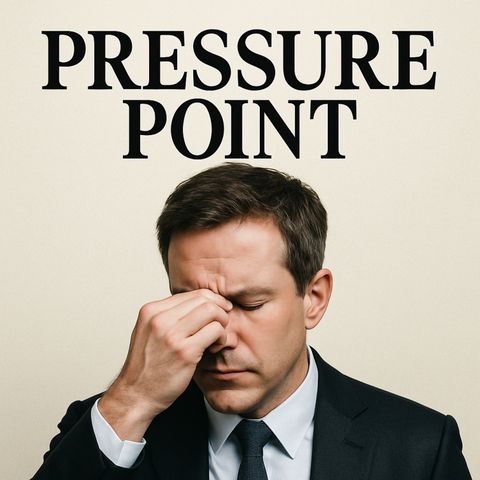
The best leaders don't have better instincts — they've just learned to override them faster. Pressure Point examines the actual moments that define leadership: the midnight layoff decision, the product...
show more
The best leaders don't have better instincts — they've just learned to override them faster. Pressure Point examines the actual moments that define leadership: the midnight layoff decision, the product recall announcement nobody wants to make, the promotion call that will follow someone for years. Drawing on behavioral science and conversations with people who've been in the room when it counted, we unpack what's really happening in a leader's head under pressure — the biases, the shortcuts, the tells that separate what leadership looks like from the outside from what it actually requires when the stakes are highest.
show less
Episodes & Posts
Episodes
Posts
26 NOV 2025 · A CEO has spent two years building a strategy, communicating it to investors, reorganizing the company around it. The market is shifting in ways they didn't anticipate. Early signals suggest the strategy might not work. But they've already burned credibility on this direction, already asked people to sacrifice for it, already told the board it would work. Admitting doubt now means admitting they were wrong, which feels like admitting they're not capable of leading the company. This episode examines the decision to stay the course or change course when the only real data is ambiguous early signals and the leader's private doubt. We explore the role of commitment and consistency bias (once we've publicly committed to something, we're motivated to justify it) and the sunk cost fallacy in its most dangerous form—when the sunk cost is credibility itself. The episode features a healthcare executive who changed strategy mid-course and faced accusations of indecision, and another who stayed the course despite mounting evidence it was wrong, and watched the company decline. What emerges is that the decision to change strategy is often less about the actual evidence and more about the leader's confidence in their ability to maintain credibility through the change. Leaders who've built strong relationships with their board and team can change course and be seen as adaptive, while those who haven't tend to be seen as flailing. The episode also examines the specific moment when a leader's private doubt becomes visible to the organization, and how that moment shapes whether people trust the new direction or interpret it as panic. We explore the lesser-known pattern: leaders who change strategy early, when the evidence is still weak, tend to be seen as visionary, while those who wait for overwhelming evidence tend to be seen as reactive. The closing segment follows the actual outcomes of both the strategy-changers and the strategy-stayers, revealing how the decision to pivot or persist often mattered less than how the leader communicated the reasoning.
19 NOV 2025 · A leader has built their team with people they trust—people who've been with them through transitions, who understand their vision, who've proven their loyalty. But the company is scaling, and now they need specialists, people with specific expertise the current team doesn't have. Bringing in outsiders means diluting the culture they've built and implicitly signaling that their trusted people aren't enough. This episode examines the decision that reveals a leader's priorities: do you optimize for team cohesion and culture, or for capability and growth? We explore the research on in-group bias (we favor people we know and trust) and the false choice between loyalty and competence that many leaders construct. The episode features a founder who kept their original team too long and watched the company struggle to scale, and another who brought in outside talent early and faced mutiny from their original crew who felt replaced. What emerges is that this isn't actually a binary choice—the tension comes from how the decision is communicated and executed. Leaders who frame outside hires as complementary tend to retain their original team's loyalty, while those who frame them as upgrades tend to trigger resentment. The episode also examines the specific moment when a leader realizes their trusted lieutenant can't grow into the role they need, and how that realization often comes too late. We explore the psychological cost of that realization—the guilt, the sense of betrayal, the question of whether the leader should have known earlier. The closing segment follows the careers of both the original team members and the outside hires, revealing how the decision shaped not just the company's trajectory but the personal trajectories of everyone involved.
5 NOV 2025 · A team leader is genuinely liked by their direct reports. They're personable, they care about their people, they show up to happy hours. But their strategic judgment is poor, their decisions are slow, and their team's output has declined. Everyone can see it except the person themselves. Firing them means disappointing people who value them, which creates a specific kind of pressure that performance-based firing doesn't. This episode examines how likability becomes a liability in leadership decisions, and why leaders often keep underperforming people longer when those people are socially skilled. We explore the role of the halo effect (we assume people who are likable are also competent) and the reciprocity principle (we feel obligated to people who are kind to us). The episode features a CEO who delayed firing a popular VP for two years, watching the division's performance deteriorate, and a founder who made the decision quickly and faced immediate backlash from employees who felt betrayed. What emerges is that the emotional cost of firing someone beloved is often higher for the leader than firing someone disliked, which creates a perverse incentive to delay. We examine the specific moment when a leader stops trying to improve someone's performance and starts managing around them, and how that moment signals to the entire organization that competence and likability are separable, and likability wins. The episode also explores the lesser-known consequence: the people who respected the fired leader often lose faith in the organization's judgment, because they see it as punishing someone for being human rather than addressing a performance gap. We close by examining how the best leaders handle this—they separate the personal value of the person from the professional fit of the role, and they communicate that separation clearly before the firing becomes necessary.
29 OCT 2025 · A junior analyst approaches a senior leader with evidence of accounting irregularities. The numbers don't add up, but the person reporting them has less experience, less credibility, and no obvious incentive to be right. The senior leader has three options: escalate and risk accusing respected colleagues of fraud, investigate quietly and risk missing a growing problem, or dismiss it and hope the analyst is wrong. This episode examines the decision that defines a leader's character before anyone else is watching—the choice to take seriously a claim that, if true, will be catastrophic, but if false, will damage relationships and reputation. We explore the role of status bias (we trust high-status people more) and the burden of proof that shifts depending on who's making the claim. The episode features interviews with leaders who escalated whistleblower concerns and uncovered major fraud, and others who dismissed them and watched the problem metastasize. What emerges is a pattern: the leaders who acted on weak evidence tended to frame it as due diligence, while those who waited for stronger evidence often framed it as prudence. But the outcomes suggest the opposite—early action, even when wrong, tends to create organizational cultures where people report problems, while delayed action, even when ultimately justified, creates cultures where people hide them. The episode also examines the specific moment when a leader's private doubt about an accusation becomes visible to the accused, and how that moment shapes the entire investigation. We close by following the career trajectories of the leaders who believed the whistleblower early versus those who didn't, revealing how that single decision often determined whether they remained in positions of trust.
22 OCT 2025 · A manager has to tell one of two equally qualified people they didn't get the promotion. Both have been with the company for years. Both performed well. The decision came down to subjective factors—one felt more ready, one seemed to have more upside. This episode examines the moment when a leader's private judgment becomes someone's public wound, and how that moment shapes not just the person who was passed over, but the entire team's interpretation of what success actually looks like at the company. We explore the research on how people interpret rejection in competitive contexts, including the role of anchoring (the promoted person becomes the new standard) and the spotlight effect (the passed-over person believes everyone is watching their reaction). The episode features the actual conversation between a tech executive and a director who was passed over for VP, including the manager's attempt to soften the blow and the director's interpretation of every word as either confirmation or denial of their value. What emerges is a fundamental mismatch: the manager is trying to communicate that the decision wasn't about capability, while the director is hearing that it was about something worse—fit, potential, or some ineffable quality they lack. We examine how leaders often make this worse by offering reassurance that sounds like consolation, and how the passed-over person's future at the company often depends less on the promotion decision itself than on whether they believe the leader's judgment was fair. The episode closes by following both the promoted and passed-over employee over the next two years, revealing how the promotion call became a pivot point—one person accelerated their trajectory, the other left the company within eighteen months.
15 OCT 2025 · A consumer goods company discovers a potential safety issue in their flagship product. The risk is real but not catastrophic—maybe one in ten thousand units has a defect. Recalling costs $40 million. Not recalling risks a lawsuit that could cost more, but only if the defect causes actual harm, which it might never do. This is the decision that lives in the gap between legal liability and moral responsibility, and it reveals how leaders actually weigh risk when the math is genuinely ambiguous. We examine the specific moment a CEO decides whether to announce a recall, including the role of availability bias (how easily we imagine worst-case scenarios), the sunk cost fallacy (all that money already spent on inventory), and the particular form of denial that emerges when a leader has already publicly committed to a product's safety. The episode features a pharmaceutical executive who announced a recall that destroyed the company's market cap but prevented potential harm, and a manufacturing leader who delayed announcement and faced criminal charges years later when the defect caused injuries. What emerges is not a clear rule but a pattern: leaders who announce early tend to frame it as responsible stewardship, while those who delay frame it as prudent caution—the same situation, completely different narrative. The closing segment examines how the announcement itself becomes a leadership test for the organization, revealing which employees trust the company's judgment and which start looking for exits.
8 OCT 2025 · A venture capital partner has 48 hours to greenlight a Series B funding round. The metrics are compelling—user growth is exponential, retention is solid, the market timing is perfect. But something feels wrong. The founder reminds them of someone who failed before. The product demo felt slick in a way that made them uneasy. This episode examines the tension between intuitive discomfort and quantified data, and why the most dangerous leadership decisions often come when these two signals conflict. We explore research on thin-slicing—the brain's ability to detect patterns too subtle for conscious articulation—and when that ability is actually reliable versus when it's just pattern-matching from past trauma. The episode features interviews with investors who ignored their gut and funded unicorns, and others who trusted their discomfort and dodged disasters. Critically, we examine the asymmetry: ignoring your gut to follow data is culturally rewarded as rational, while ignoring data to follow your gut is often framed as reckless, even when the outcomes suggest otherwise. The episode closes by revealing what the most experienced decision-makers actually do—they don't choose between gut and data, they use the discomfort as a signal to investigate harder, to find the data point they've been missing.
1 OCT 2025 · Most leaders describe layoffs as the hardest decision they'll ever make. But what's actually happening in those hours before the announcement? This opening explores the psychological machinery that activates when a leader must eliminate jobs they created, including the cognitive biases that make the decision feel both inevitable and unbearable. We follow a manufacturing CEO through the 36 hours before announcing a 15% reduction, tracking how confirmation bias narrows their thinking, how loss aversion makes them delay, and how the sunk cost fallacy keeps them justifying roles that no longer exist. The episode examines why leaders often feel relief after the announcement—not because they've solved the problem, but because the ambiguity is gone. We also uncover the lesser-known pattern: leaders who delay layoffs often cause more total damage than those who act decisively, because the uncertainty itself becomes toxic. The final segment returns to the people affected, revealing how the timing and framing of the announcement shaped not just who left, but how the survivors interpreted their own future at the company.
The best leaders don't have better instincts — they've just learned to override them faster. Pressure Point examines the actual moments that define leadership: the midnight layoff decision, the product...
show more
The best leaders don't have better instincts — they've just learned to override them faster. Pressure Point examines the actual moments that define leadership: the midnight layoff decision, the product recall announcement nobody wants to make, the promotion call that will follow someone for years. Drawing on behavioral science and conversations with people who've been in the room when it counted, we unpack what's really happening in a leader's head under pressure — the biases, the shortcuts, the tells that separate what leadership looks like from the outside from what it actually requires when the stakes are highest.
show less
Information
| Author | 3Peaks |
| Organization | 3Peaks |
| Categories | Business |
| Website | www.spreaker.com |
| ops@3peakspodcasts.com |

Copyright 2026 - Spreaker Inc. an iHeartMedia Company
