Transcribed
Why Your Critical Path Changes When Production Changes
Sep 14, 2026 ·
1h 51m 16s
Download and listen anywhere
Download your favorite episodes and enjoy them, wherever you are! Sign up or log in now to access offline listening.
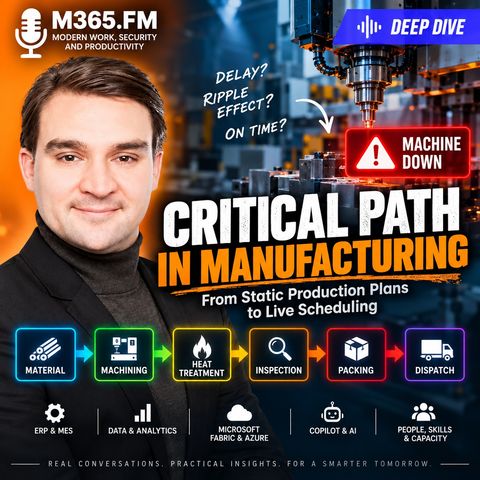
Why Your Critical Path Changes When Production Changes
Description
A production plan can look perfectly reasonable — until production actually starts.One machine runs late. A material release slips. A qualified operator becomes unavailable. A quality inspection takes longer than...
show more
A production plan can look perfectly reasonable — until production actually starts.One machine runs late. A material release slips. A qualified operator becomes unavailable. A quality inspection takes longer than expected. A batch misses its furnace window. Suddenly, a delay of only a few hours can put an entire customer delivery at risk.In this deep dive, we explore how the Critical Path Method (CPM) can be adapted from traditional project management to modern manufacturing and production planning.The central idea is simple: the critical path in manufacturing should not be treated as a fixed sequence created when the production order was released.Instead, manufacturers need to understand the live chain of dependencies that currently determines the earliest possible completion and shipment date.That chain can change throughout the production day.A machine breakdown may initially be the problem. Once the machine recovers, however, the critical dependency could move to a furnace slot, a qualified operator, an inspection queue, a missing fixture, a quality release, or even the carrier cutoff at the end of the process.This episode examines how manufacturers can connect production orders, machines, materials, people, quality states, ERP, MES, IoT, and shop-floor events into a dependency model capable of supporting more dynamic production scheduling.
WHY CRITICAL PATH METHOD MATTERS IN MANUFACTURING
Critical Path Method is normally associated with project management.A project contains tasks with durations and dependencies. Some activities can run in parallel, while others cannot begin until previous work has finished.The critical path represents the sequence of dependent activities that determines the earliest possible project completion date.Manufacturing has many of the same characteristics.A released production order contains operations that need to happen in a particular sequence. Those operations can depend on:
WHEN ONE LATE OPERATION CHANGES THE DELIVERY DATE
Consider a machine assembly that must ship by the end of the week.Its route could include:
THE CRITICAL PATH IS NOT STATIC
In manufacturing, the critical path can move.Before a disruption, machining might control the completion date. After machining recovers, the next furnace window might become critical. After heat treatment, inspection could become critical because there is almost no time remaining before packing and dispatch.The operational constraint has moved.This distinction is important because simply expediting the operation that appears late doesn't necessarily recover the customer date.If an order has already missed the furnace slot required to protect its shipment date, pushing machining harder may achieve nothing unless the furnace schedule can also change.A live critical path therefore needs to follow the complete dependency chain rather than focusing only on individual late operations.
MATERIAL READINESS CAN BECOME THE CRITICAL PATH
Production problems can begin before a machine starts.A purchase order might show that material will arrive on Friday. Planning therefore schedules machining for Monday.But physical delivery does not necessarily mean production readiness.The material might still require:
SHARED MACHINES CONNECT DIFFERENT PRODUCTION ORDERS
Finite capacity introduces another layer of dependency.Imagine four production orders waiting for the same five-axis machining center.Every individual routing might look feasible. But the machine can process only one job at a time.The sequencing decision at that machine can therefore change the delivery dates of several unrelated customer orders.A short machining job can even delay another order by an entire day if it prevents that second order from reaching a time-sensitive downstream process.This means production orders can become indirectly connected through shared resources.The live critical path may therefore include not only operations belonging to the affected order, but also other work occupying the resource that order requires.
AVAILABLE CAPACITY IS NOT ALWAYS USABLE CAPACITY
A machine appearing available in the planning system doesn't necessarily mean an operation can begin.The operation might require:
PEOPLE, SKILLS, AND SHIFT CALENDARS MATTER
The same principle applies to labor.A machine can be available while no qualified person is available to operate it.An operation might require a specialist for:
MACHINE STATUS IS NOT PRODUCTION READINESS
Another major challenge is interpreting shop-floor machine data.A machine may report that it is available or running. That does not necessarily mean it is ready for the next production order.After maintenance, the equipment may still require:
Become a supporter of this podcast: https://www.spreaker.com/podcast/m365-fm-a-microsoft-mvp-podcast-by-mirko-peters--6704921/support.
show less
WHY CRITICAL PATH METHOD MATTERS IN MANUFACTURING
Critical Path Method is normally associated with project management.A project contains tasks with durations and dependencies. Some activities can run in parallel, while others cannot begin until previous work has finished.The critical path represents the sequence of dependent activities that determines the earliest possible project completion date.Manufacturing has many of the same characteristics.A released production order contains operations that need to happen in a particular sequence. Those operations can depend on:
- Machine availability
- Material availability
- Qualified operators
- Fixtures and tooling
- Inspection results
- Quality releases
- Batch windows
- Maintenance schedules
- Shift calendars
- Process approvals
- Downstream capacity
- Packing and dispatch requirements
WHEN ONE LATE OPERATION CHANGES THE DELIVERY DATE
Consider a machine assembly that must ship by the end of the week.Its route could include:
- Machining
- Heat treatment
- Surface finishing
- Final inspection
- Packing
- Dispatch
THE CRITICAL PATH IS NOT STATIC
In manufacturing, the critical path can move.Before a disruption, machining might control the completion date. After machining recovers, the next furnace window might become critical. After heat treatment, inspection could become critical because there is almost no time remaining before packing and dispatch.The operational constraint has moved.This distinction is important because simply expediting the operation that appears late doesn't necessarily recover the customer date.If an order has already missed the furnace slot required to protect its shipment date, pushing machining harder may achieve nothing unless the furnace schedule can also change.A live critical path therefore needs to follow the complete dependency chain rather than focusing only on individual late operations.
MATERIAL READINESS CAN BECOME THE CRITICAL PATH
Production problems can begin before a machine starts.A purchase order might show that material will arrive on Friday. Planning therefore schedules machining for Monday.But physical delivery does not necessarily mean production readiness.The material might still require:
- Incoming inspection
- Certificate verification
- Quality approval
- Dimensional checks
- Lot release
- Traceability verification
SHARED MACHINES CONNECT DIFFERENT PRODUCTION ORDERS
Finite capacity introduces another layer of dependency.Imagine four production orders waiting for the same five-axis machining center.Every individual routing might look feasible. But the machine can process only one job at a time.The sequencing decision at that machine can therefore change the delivery dates of several unrelated customer orders.A short machining job can even delay another order by an entire day if it prevents that second order from reaching a time-sensitive downstream process.This means production orders can become indirectly connected through shared resources.The live critical path may therefore include not only operations belonging to the affected order, but also other work occupying the resource that order requires.
AVAILABLE CAPACITY IS NOT ALWAYS USABLE CAPACITY
A machine appearing available in the planning system doesn't necessarily mean an operation can begin.The operation might require:
- A particular fixture
- An approved CNC program
- Specific tooling
- A qualified machine configuration
- A certain product revision
- A calibrated test system
- A qualified operator
PEOPLE, SKILLS, AND SHIFT CALENDARS MATTER
The same principle applies to labor.A machine can be available while no qualified person is available to operate it.An operation might require a specialist for:
- Setup
- First-piece inspection
- Process approval
- Final release
- Quality verification
- Specialized machine operation
MACHINE STATUS IS NOT PRODUCTION READINESS
Another major challenge is interpreting shop-floor machine data.A machine may report that it is available or running. That does not necessarily mean it is ready for the next production order.After maintenance, the equipment may still require:
- Warm-up cycles
- Fixture changes
- Tool checks
- Probe verification
- Cleaning
- Calibration
- Setup
- Program approval
Become a supporter of this podcast: https://www.spreaker.com/podcast/m365-fm-a-microsoft-mvp-podcast-by-mirko-peters--6704921/support.
Information
| Author | Mirko Peters (M365 Consultant) |
| Organization | m365 FM |
| Website | - |
| Tags |

Copyright 2026 - Spreaker Inc. an iHeartMedia Company

Comments