Transcribed
Microsoft Cloud Adoption Framework - Simply Explained
Aug 11, 2026 ·
18m 46s
Download and listen anywhere
Download your favorite episodes and enjoy them, wherever you are! Sign up or log in now to access offline listening.
Microsoft Cloud Adoption Framework - Simply Explained
Description
Microsoft Cloud Adoption Framework, commonly called CAF, helps organizations avoid one of the most common cloud mistakes: moving into Azure before deciding how the environment should actually work. Creating an...
show more
Microsoft Cloud Adoption Framework, commonly called CAF, helps organizations avoid one of the most common cloud mistakes: moving into Azure before deciding how the environment should actually work. Creating an Azure subscription and deploying a virtual machine is easy. Building an environment where applications, security, networking, costs, governance, and operational responsibilities remain manageable as the organization grows is much harder. CAF provides Microsoft's structured guidance for that journey. It helps organizations decide why they're adopting Azure, plan what should move, prepare the Azure foundation, migrate or modernize workloads, establish governance, and operate the environment over time.
ㅤ
WHY THE CLOUD NEEDS A PLAN
Azure gives organizations enormous flexibility. Teams can create virtual machines, databases, storage, networks, applications, and many other services within minutes. But flexibility doesn't automatically produce good architecture. Without shared decisions, one team might expose services publicly because it's convenient. Another might create expensive resources without clear cost ownership. Another could deploy an application before the required network connectivity exists. Eventually nobody knows exactly who owns what, why resources exist, or who is responsible when something fails. CAF provides a framework for making those decisions before this becomes normal.
ㅤ
WHAT IS THE CLOUD ADOPTION FRAMEWORK?
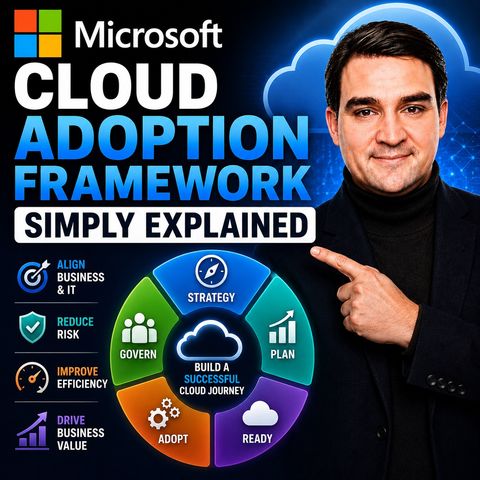
The Microsoft Cloud Adoption Framework isn't an Azure product you install. It isn't a certification. And it isn't a button that automatically creates the perfect Azure environment. Instead, CAF provides guidance for organizing the decisions, responsibilities, architecture, governance, and operational processes required for cloud adoption. Its core journey can be understood through Strategy, Plan, Ready, Adopt, Govern, Secure, and Manage activities.
ㅤ
STRATEGY: WHY ARE YOU MOVING TO AZURE?
Cloud adoption shouldn't begin with the question, "Which Azure service should we buy?" Start with the business problem. An organization might need to leave an aging data center. Product teams may need to release software faster. Applications might need to serve users in multiple regions. The organization could require better disaster recovery or more transparent cloud spending. These objectives lead to different technical decisions. The strategy should therefore describe measurable outcomes rather than simply stating that the organization wants to "move to the cloud."
ㅤ
TURN BUSINESS GOALS INTO MEASURABLE OUTCOMES
Useful cloud goals are specific. "Move these ten servers before hardware support ends" gives teams a deadline and measurable result. "Reduce application release time from weeks to days" connects cloud adoption to development productivity. "Give every department a cloud budget with an identified owner" creates financial accountability. These objectives help technical, business, security, and finance teams understand what success actually means.
ㅤ
PLAN: UNDERSTAND WHAT YOU ACTUALLY HAVE
Once the objective is clear, planning turns strategy into practical work. Organizations need an inventory of applications, data, dependencies, owners, skills, risks, and timelines. Dependencies are particularly important. An apparently simple application might depend on a database, shared file location, authentication service, scheduled task, and another business application. Moving only the visible server without understanding those relationships can result in a migration that technically completed but left the application unable to operate.
ㅤ
CHOOSE THE RIGHT MIGRATION PATH
Not every workload should move to Azure in the same way. Some applications can be rehosted, commonly called lift and shift. The existing application moves to Azure with relatively few changes. Others can be replatformed by moving individual components to managed Azure services. Some applications benefit from refactoring or rebuilding. Others might be replaced with a SaaS product or remain outside Azure entirely. Cloud adoption doesn't mean everything must move. The correct approach depends on the workload, business objective, risk, cost, and available time.
ㅤ
DON'T START WITH YOUR WORST APPLICATION
Organizations sometimes choose their oldest and most problematic application as their first Azure migration because it feels urgent. That can create a difficult first experience. The application may be poorly documented, dependent on forgotten systems, and understood by very few people. A better first workload is important enough to provide meaningful lessons but simple enough that its architecture, ownership, data, and success criteria are understood. The first migration should help the organization learn how its cloud model works.
ㅤ
READY: PREPARE AZURE BEFORE WORKLOADS ARRIVE
The Ready phase prepares the Azure environment. One of the central concepts is the Azure landing zone. A landing zone is a prepared Azure environment where applications and data can operate within established identity, networking, security, governance, monitoring, and organizational boundaries. Instead of allowing every application team to independently invent these foundations, the organization creates an environment workloads can safely enter.
ㅤ
WHAT IS AN AZURE LANDING ZONE?
Think of an Azure landing zone like preparing an office before employees arrive. The building needs electricity, doors, network connectivity, security, shared facilities, and rules. You wouldn't move hundreds of employees into an empty building and tell every department to design its own electrical system and security model. Azure landing zones apply the same principle to cloud infrastructure. Common foundational decisions are prepared before workloads arrive.
ㅤ
IDENTITY WITH MICROSOFT ENTRA ID
Identity is one of those foundational components. Microsoft Entra ID controls digital identities and helps determine who or what can access Azure resources. Users should receive only the permissions required to perform their work. Applications and services should follow the same principle. Giving everyone broad permissions might initially appear easier, but it increases the impact of mistakes and compromised identities.
ㅤ
ORGANIZING AZURE RESOURCES
Azure provides several organizational layers. Management groups can apply shared governance across multiple subscriptions. Subscriptions provide boundaries for areas such as billing, access, and workloads. Resource groups organize related Azure resources inside subscriptions. Naming conventions and tags provide additional context such as workload owner, department, environment, or cost center. The objective is to make the Azure environment understandable rather than creating a complicated naming system that nobody can remember.
ㅤ
NETWORKING IS PART OF THE FOUNDATION
Azure networking determines how workloads communicate with each other, with the internet, and with systems that remain outside Azure. Some applications require private connectivity to databases. Others need public connectivity for customers. Certain systems should never communicate directly with one another. A landing zone establishes these connectivity patterns before every workload team independently creates its own approach.
ㅤ
PLATFORM AND APPLICATION LANDING ZONES
Organizations can separate shared platform capabilities from individual workload environments. A platform landing zone can provide shared services such as identity, networking, monitoring, backup, and security. Application landing zones provide spaces for individual workloads or teams. A customer website and an internal finance application might therefore operate in different application landing zones while still using the organization's shared identity, networking, monitoring, and governance approach.
ㅤ
AZURE POLICY
Azure Policy can enforce or evaluate organizational rules. Organizations might require specific tags so every resource has an owner. They might restrict deployments to approved Azure regions. Storage configurations allowing inappropriate public access could be blocked. The objective isn't to make Azure difficult to use. Policy should prevent predictable mistakes while still giving teams a clear path for deploying legitimate workloads.
ㅤ
DON'T BUILD EVERYTHING ON DAY ONE
Microsoft architecture diagrams can make cloud adoption appear enormous. A small organization doesn't need every possible enterprise component before deploying its first workload. The environment should match the organization's actual requirements. Start with the foundations you need, deploy representative workloads, learn from them, and improve the landing zone as real requirements emerge. A landing zone that looks perfect on a diagram can still encounter unexpected application requirements when real workloads arrive.
ㅤ
ADOPT: MOVE AND MODERNIZE WORKLOADS
The Adopt phase is where workloads begin moving into the prepared Azure environment. This can include migrating existing applications as well as modernizing them to take greater advantage of cloud services. A workload might be a website, database, business application, or collection of connected services. The important point is that deployment isn't complete simply because an application starts successfully.
Become a supporter of this podcast: https://www.spreaker.com/podcast/m365-fm-microsoft-365-azure-cloud-power-platform-ai--6704921/support.
show less
ㅤ
WHY THE CLOUD NEEDS A PLAN
Azure gives organizations enormous flexibility. Teams can create virtual machines, databases, storage, networks, applications, and many other services within minutes. But flexibility doesn't automatically produce good architecture. Without shared decisions, one team might expose services publicly because it's convenient. Another might create expensive resources without clear cost ownership. Another could deploy an application before the required network connectivity exists. Eventually nobody knows exactly who owns what, why resources exist, or who is responsible when something fails. CAF provides a framework for making those decisions before this becomes normal.
ㅤ
WHAT IS THE CLOUD ADOPTION FRAMEWORK?
The Microsoft Cloud Adoption Framework isn't an Azure product you install. It isn't a certification. And it isn't a button that automatically creates the perfect Azure environment. Instead, CAF provides guidance for organizing the decisions, responsibilities, architecture, governance, and operational processes required for cloud adoption. Its core journey can be understood through Strategy, Plan, Ready, Adopt, Govern, Secure, and Manage activities.
ㅤ
STRATEGY: WHY ARE YOU MOVING TO AZURE?
Cloud adoption shouldn't begin with the question, "Which Azure service should we buy?" Start with the business problem. An organization might need to leave an aging data center. Product teams may need to release software faster. Applications might need to serve users in multiple regions. The organization could require better disaster recovery or more transparent cloud spending. These objectives lead to different technical decisions. The strategy should therefore describe measurable outcomes rather than simply stating that the organization wants to "move to the cloud."
ㅤ
TURN BUSINESS GOALS INTO MEASURABLE OUTCOMES
Useful cloud goals are specific. "Move these ten servers before hardware support ends" gives teams a deadline and measurable result. "Reduce application release time from weeks to days" connects cloud adoption to development productivity. "Give every department a cloud budget with an identified owner" creates financial accountability. These objectives help technical, business, security, and finance teams understand what success actually means.
ㅤ
PLAN: UNDERSTAND WHAT YOU ACTUALLY HAVE
Once the objective is clear, planning turns strategy into practical work. Organizations need an inventory of applications, data, dependencies, owners, skills, risks, and timelines. Dependencies are particularly important. An apparently simple application might depend on a database, shared file location, authentication service, scheduled task, and another business application. Moving only the visible server without understanding those relationships can result in a migration that technically completed but left the application unable to operate.
ㅤ
CHOOSE THE RIGHT MIGRATION PATH
Not every workload should move to Azure in the same way. Some applications can be rehosted, commonly called lift and shift. The existing application moves to Azure with relatively few changes. Others can be replatformed by moving individual components to managed Azure services. Some applications benefit from refactoring or rebuilding. Others might be replaced with a SaaS product or remain outside Azure entirely. Cloud adoption doesn't mean everything must move. The correct approach depends on the workload, business objective, risk, cost, and available time.
ㅤ
DON'T START WITH YOUR WORST APPLICATION
Organizations sometimes choose their oldest and most problematic application as their first Azure migration because it feels urgent. That can create a difficult first experience. The application may be poorly documented, dependent on forgotten systems, and understood by very few people. A better first workload is important enough to provide meaningful lessons but simple enough that its architecture, ownership, data, and success criteria are understood. The first migration should help the organization learn how its cloud model works.
ㅤ
READY: PREPARE AZURE BEFORE WORKLOADS ARRIVE
The Ready phase prepares the Azure environment. One of the central concepts is the Azure landing zone. A landing zone is a prepared Azure environment where applications and data can operate within established identity, networking, security, governance, monitoring, and organizational boundaries. Instead of allowing every application team to independently invent these foundations, the organization creates an environment workloads can safely enter.
ㅤ
WHAT IS AN AZURE LANDING ZONE?
Think of an Azure landing zone like preparing an office before employees arrive. The building needs electricity, doors, network connectivity, security, shared facilities, and rules. You wouldn't move hundreds of employees into an empty building and tell every department to design its own electrical system and security model. Azure landing zones apply the same principle to cloud infrastructure. Common foundational decisions are prepared before workloads arrive.
ㅤ
IDENTITY WITH MICROSOFT ENTRA ID
Identity is one of those foundational components. Microsoft Entra ID controls digital identities and helps determine who or what can access Azure resources. Users should receive only the permissions required to perform their work. Applications and services should follow the same principle. Giving everyone broad permissions might initially appear easier, but it increases the impact of mistakes and compromised identities.
ㅤ
ORGANIZING AZURE RESOURCES
Azure provides several organizational layers. Management groups can apply shared governance across multiple subscriptions. Subscriptions provide boundaries for areas such as billing, access, and workloads. Resource groups organize related Azure resources inside subscriptions. Naming conventions and tags provide additional context such as workload owner, department, environment, or cost center. The objective is to make the Azure environment understandable rather than creating a complicated naming system that nobody can remember.
ㅤ
NETWORKING IS PART OF THE FOUNDATION
Azure networking determines how workloads communicate with each other, with the internet, and with systems that remain outside Azure. Some applications require private connectivity to databases. Others need public connectivity for customers. Certain systems should never communicate directly with one another. A landing zone establishes these connectivity patterns before every workload team independently creates its own approach.
ㅤ
PLATFORM AND APPLICATION LANDING ZONES
Organizations can separate shared platform capabilities from individual workload environments. A platform landing zone can provide shared services such as identity, networking, monitoring, backup, and security. Application landing zones provide spaces for individual workloads or teams. A customer website and an internal finance application might therefore operate in different application landing zones while still using the organization's shared identity, networking, monitoring, and governance approach.
ㅤ
AZURE POLICY
Azure Policy can enforce or evaluate organizational rules. Organizations might require specific tags so every resource has an owner. They might restrict deployments to approved Azure regions. Storage configurations allowing inappropriate public access could be blocked. The objective isn't to make Azure difficult to use. Policy should prevent predictable mistakes while still giving teams a clear path for deploying legitimate workloads.
ㅤ
DON'T BUILD EVERYTHING ON DAY ONE
Microsoft architecture diagrams can make cloud adoption appear enormous. A small organization doesn't need every possible enterprise component before deploying its first workload. The environment should match the organization's actual requirements. Start with the foundations you need, deploy representative workloads, learn from them, and improve the landing zone as real requirements emerge. A landing zone that looks perfect on a diagram can still encounter unexpected application requirements when real workloads arrive.
ㅤ
ADOPT: MOVE AND MODERNIZE WORKLOADS
The Adopt phase is where workloads begin moving into the prepared Azure environment. This can include migrating existing applications as well as modernizing them to take greater advantage of cloud services. A workload might be a website, database, business application, or collection of connected services. The important point is that deployment isn't complete simply because an application starts successfully.
Become a supporter of this podcast: https://www.spreaker.com/podcast/m365-fm-microsoft-365-azure-cloud-power-platform-ai--6704921/support.
Information
| Author | Mirko Peters M365, Azure & AI |
| Organization | m365 FM |
| Website | - |
| Tags |

Copyright 2026 - Spreaker Inc. an iHeartMedia Company

Comments