Support the Podcast
Contacts
Info
The thoughts of two CIPS award winning procurement gods who want to share our love of procurement with newbies, oldies and the procurious. Generally we'll be talking nonsense about all...
show more
The thoughts of two CIPS award winning procurement gods who want to share our love of procurement with newbies, oldies and the procurious. Generally we'll be talking nonsense about all things procurement, with the occasional nugget of priceless insight.
All views are our own - we're not affiliated in any way to anybody or anything!
Er, except Kodiak Hub...who are sponsoring our shows. How smart of them.
show less
All views are our own - we're not affiliated in any way to anybody or anything!
Er, except Kodiak Hub...who are sponsoring our shows. How smart of them.
Support the Podcast
Episodes & Posts
Episodes
Posts
17 NOV 2026 · Death & Taxes. You can cheat them both with superior procurement skills (and lots of cash).
Learn how with one of our lovely Procurement Says No Videos. Only this one is audio only.
Another video which we said we'd never do.
They're on TikTok and YouTube (occasionally) in full glorious video.
Now powered by www.KodiakHub.com. The smart SRM 3-piece suite. Become a supporter of this podcast: https://www.spreaker.com/podcast/procurement-says-no--5886102/support.

17 NOV 2026 · (Or How Procurement Finally Admitted That Waiting Fourteen Weeks for a Screw Might Not Be a Brilliant Strategy)
The era of hyper-globalisation, characterised by chasing the lowest possible invoice price across oceans, is officially over. Driven by geopolitical tension, tariff volatility and environmental regulation, the corporate boardroom has undergone a fundamental mindset shift. More like Ctrl-Alt-Delete.
It's taken time, though, and a sudden realisation that if a factory was located on another continent, communication required at least three time zones, two translators and a willingness to attend meetings at genuinely offensive hours of the morning, somebody in Procurement would inevitably describe it as a strategic sourcing success story.
The fact that nobody had visited the site for years, nobody could confidently explain exactly how goods travelled from manufacturer to customer, and nobody had any idea what would happen if the shipping route became unavailable was largely considered somebody else's problem. In some organisations, even the agreed Incoterms had achieved an almost mythical status, spoken about occasionally but rarely observed in their natural habitat.
Procurement has apparently transitioned from a cost-cutting back-office function to a core driver of corporate resilience. We're still waiting for the badge.
For two decades, procurement professionals sat through presentations in which spreadsheets triumphantly demonstrated savings of 17.4 percent, whilst quietly wondering whether anybody else had noticed those savings relied upon a supply chain stretching halfway around the globe, balanced precariously upon assumptions that had never really been tested. As long as ships sailed, ports remained open and geopolitics stayed reasonably calm, the model worked. Or at least it appeared to.
What began as a panic-driven reaction to pandemic disruption has become a permanent strategy. Organisations are no longer asking whether production should move closer to home, but how to balance regional agility with global cost efficiency. The result is a global economy increasingly defined by regional manufacturing corridors, advanced automation and a much closer examination of risk.
Suddenly the board wanted to discuss resilience, continuity, inventory and lead times. People who had previously shown little interest in global trade routes found themselves developing strong opinions on the Strait of Hormuz despite only recently discovering where it was.
The Strategic Shift to "Right-Shoring"
At the heart of this transformation is the rise of near-shoring and re-shoring. Predictably, consultants immediately invented new terminology, and the current favourite is "right-shoring", which is corporate language for admitting that neither full globalisation nor complete localisation makes much sense. Here at PSN Towers, we prefer "Goldilocks Shoring".
Despite the political rhetoric, very few organisations are bringing every aspect of production back home. The economics simply don't work. Building new facilities requires enormous capital investment, skilled labour remains scarce and many supply chains have become too complex to recreate within a single country.
Instead, businesses are increasingly adopting dual-sourcing models that create balance rather than dependency. Production remains in established manufacturing hubs such as East Asia, while additional capacity is developed closer to major markets.
The clever bit is that this near-shore capacity acts as a strategic buffer. If a geopolitical crisis, labour strike or natural disaster disrupts an ocean route, production can scale regionally. Rather than tying up capital in months of safety stock, organisations can reduce lead times from fourteen weeks to six and respond far more quickly to changing demand.
Viewed through this lens, right-shoring is less about abandoning globalisation and more about purchasing insurance. Unlike most insurance policies, though, this one occasionally pays out even before you've had the accident.
The Architecture of Regional Power Corridors
This logic explains why distinct regional manufacturing corridors are emerging around the world.
The Americas: The Mexican Industrial Boom
In North America, Mexico has become the centrepiece of an extraordinary industrial transformation. Cities such as Monterrey, Saltillo and Querétaro have evolved into major automotive, aerospace and electronics manufacturing hubs.
To ease capacity pressures and rising labour costs, procurement teams are increasingly extending supplier networks into countries such as Guatemala and Honduras. For organisations serving the US market, the benefits are obvious. Products move quickly, tariff exposure can often be managed effectively and suppliers remain close enough to visit without requiring vaccinations, jet lag and three connecting flights.
Europe: The Mediterranean and Eastern European Network
European supply chains have increasingly gravitated towards countries such as Poland, Romania, Turkey, Morocco and Egypt.
When goods can be transported by road or rail within days rather than spending weeks at sea, entire categories of uncertainty disappear. Procurement teams spend less time worrying about containers and port congestion and more time focusing on supplier development, performance and value creation.
Regulatory Squeezes and the Redefinition of TCO
The momentum behind near-shoring is accelerated by a tightening regulatory vice that penalises long-distance logistics. Chief among these is the European Union's Carbon Border Adjustment Mechanism, or CBAM, which sounds like super duper bureaucratic fun to us.
Shipping heavy, carbon-intensive goods across thousands of miles now carries a significant financial penalty, regardless of how many trees appear in the sustainability report. Near-shoring strips carbon from the logistics tail, turning sustainability from a marketing slogan into a cost-saving measure.
At the same time, the mathematical models used to evaluate suppliers have changed dramatically. Historically, sourcing decisions were dictated by ex-works price. Today, advanced procurement organisations use Total Cost of Ownership models and predictive analytics, which is consultant-speak for putting more numbers into spreadsheets and charging extra for the privilege.
Modern TCO Calculation
Old Formula
Unit Invoice Price + Direct Freight = Sourcing Decision
New Formula
Unit Price + Sea Volatility + Working Capital + Carbon Levies + Customs Tariffs + Disruption Risk = Sourcing Decision
These models assign real financial value to factors once treated as externalities: inventory stranded on the ocean, customs delays, tariff changes and the existential cost of a stock-out, otherwise known as somebody else's problem.
When these costs are properly calculated, a near-shore supplier that appears 15% more expensive often turns out to be the better commercial choice.
This can be an uncomfortable revelation for organisations that have spent years celebrating low-cost-country sourcing.
It turns out that buying the cheapest thing isn't always the cheapest thing. Who knew?
It's certainly not cheap as crisps when the packet is empty.
Bridging the Labour Gap with Physical AI
The historical barrier to near-shoring has always been the wage gap between developed markets and developing economies, alongside factors such as tax rates, borrowing costs and environmental compliance. The factor closing that gap is automation.
Enterprises are pairing local talent with AI, computer vision and collaborative robotics, allowing factories to operate with unprecedented efficiency through lights-out shifts and highly automated production.
Robots don't particularly care where the factory is located, whether tariffs have changed, or whether they're working in darkness. They do, however, occasionally require rebooting by Dave from Maintenance, which remains one of the few advantages humans still possess.
By automating repetitive tasks, labour becomes a smaller component of overall product cost. Human workers are increasingly focused on maintenance, quality engineering and process optimisation. The result is that regional production is becoming genuinely competitive with traditional low-cost sourcing.
Conclusion: The New Imperative for Procurement Leaders
The restructuring of global supply chains through right-shoring is not temporary, it is a permanent rewrite of global commerce. Organisations that succeed will be those that view their supply chain not as a chain, but as an agile regional network capable of adapting in real time.
For procurement professionals, the mandate is clear. Success requires investment in regional supplier development, regulatory understanding and better TCO analysis.
Globalisation hasn't disappeared. The world is not fragmenting into isolated economic islands. What is disappearing, however, is the assumption that the lowest invoice price automatically represents the smartest commercial decision.
Procurement used to be encouraged to source everything from as far away as possible because a spreadsheet said it was cheaper.
Building shorter, smarter and resilient supply networks, makes organisations far better insulated against an unpredictable world.
If the last few years have taught procurement anything, it's that a screw travelling 8,000 miles to reach your factory is only cheap until the moment you actually need it.
9 NOV 2026 · Rich and Ed talk about AI quite a lot this time, because that's all anybody seems to talk about at the moment. They even have real examples and seem to know what they are on about (or possibly winging it - only you can decide).
We have news of 60 new "proctech" start ups, most of which we don't believe or understand; we have contradictory data about the use of AI in procurement (shock); news of CIPS @COP31 (oh, the air miles, the carbon footprint); building defence through buying indigenously (is that a real phrase?); and we discuss just what exactly is WAR! good for - absolutely nothing or perhaps improving innovation, particularly in drone technology.
Plus more questions from our listener(s):
- One who is concerned that their bid responses from suppliers are written by AI (and therefore at least or only 80% correct) - we tell you how to spot that pesky AI response.
- Another who asks what happens when AI takes over their negotiations - should real people also be involved and will a sky-setting-fire scenario result be inevitable.
- What free AI is available for cheap-shot procurement teams with no budget?
- And, a dull person in Swindon wants to know how to focus their risk analyses.
And remember to check out our wonderful "Ask Rich and Ed bot" AI companion app - which will answer all of your questions with genius and brilliance. It's now even got a "mind map" of Rich and Ed's brains. We couldn't believe it! You won't either - so click the link below to be amazed...
https://mentaraiq.com/share/chatbot/0e874f81-612c-46e5-8c7d-b1a8fc7ee544
Procurement Says No is now sponsored by Kodiak Hub - The SRM suite that makes you super smart. Like a smart watch where you can check your vitals and your messages at the same time. www.KodiakHub.com Become a supporter of this podcast: https://www.spreaker.com/podcast/procurement-says-no--5886102/support.
Transcribed
20 OCT 2026 · More mini bite-sized podcast chunks. Like dog food.
We get lots of questions from our listener(s) on Procurement Says No. Now you can listen to them all again even if you have very low attention levels. Whoop.
In episode 31 we answer the most important questions of our age:
- How to negotiate with Trump to stop bombing your country and let some ships through the Straits of Hormuz.
- Are you a procurement hypocrite if your role is managing your supplier carbon footprint metrics whilst your business produces 130m plastic bottles?
All of the procurement questions, all of the time. Hot damn.
www.procurementsaysno.com
Now sponsored by www.KodiakHub.com. The SRM suite that makes you super stylish.
Like a stylish thing. Become a supporter of this podcast: https://www.spreaker.com/podcast/procurement-says-no--5886102/support.
5 OCT 2026 · Rich and Ed welcome Kavita Cooper (never Coupa) to tell us all about WANS, BT and her entrepreneurial life as CEO of Buying Station.
Buying Station is a sooper dooper, cheap as crisps, end-to-end procurement system for SMEs, charidees, anyone and everyone who'd like a lovely P2P and sourcing system for peanuts.
We ask her how it all started and where it's going next; we talk about omni-platforms, I2P, orchestration and lots of other buzzwords such as intelligence hubs and "the roadmap".
It's all such fun that Kavita couldn't stop laughing. You will too. Or won't.
And remember to check out our wonderful "Ask Rich and Ed bot" AI companion app - which will answer all of your questions with genius and brilliance. We couldn't believe it! You won't either - so click the link below to be amazed...
https://mentaraiq.com/share/chatbot/0e874f81-612c-46e5-8c7d-b1a8fc7ee544
Procurement Says No is now sponsored by Kodiak Hub - The SRM suite that makes you super smart. Check you out with your fancy plaid suit. www.KodiakHub.com Become a supporter of this podcast: https://www.spreaker.com/podcast/procurement-says-no--5886102/support.
Transcribed
21 SEP 2026 · We get lots of questions from our listener(s) on Procurement Says No. Now you can listen to them all again in our series of mini bite-sized podcast chunks. Like dog food.
In episode 30 we've gone mostly cyber...
- What level of cyber security should I buy for my $200m pharma packaging business?
- What level of cyber security should I buy for my traditional weaving business using industrial looms?
- If you work in a cyber business, should you outsource your cyber security?
- What's the difference between a statement of work (SOW) and a works order (WO) (not a trick question)?
All of the procurement questions, all of the time. Woohoo.
www.procurementsaysno.com
Now sponsored by www.KodiakHub.com. The SRM suite that makes you smarter.
Like a smart thing. Become a supporter of this podcast: https://www.spreaker.com/podcast/procurement-says-no--5886102/support.
Transcribed
11 SEP 2026 · How to do market research in Procurement. No need for those big research companies anymore. DIY with AI.
Another video which we said we'd never do. Except this is audio only.
They're on TikTok and YouTube (shorts) in full glorious video.
Now powered by www.KodiakHub.com. The smart SRM 3-piece suite. Become a supporter of this podcast: https://www.spreaker.com/podcast/procurement-says-no--5886102/support.
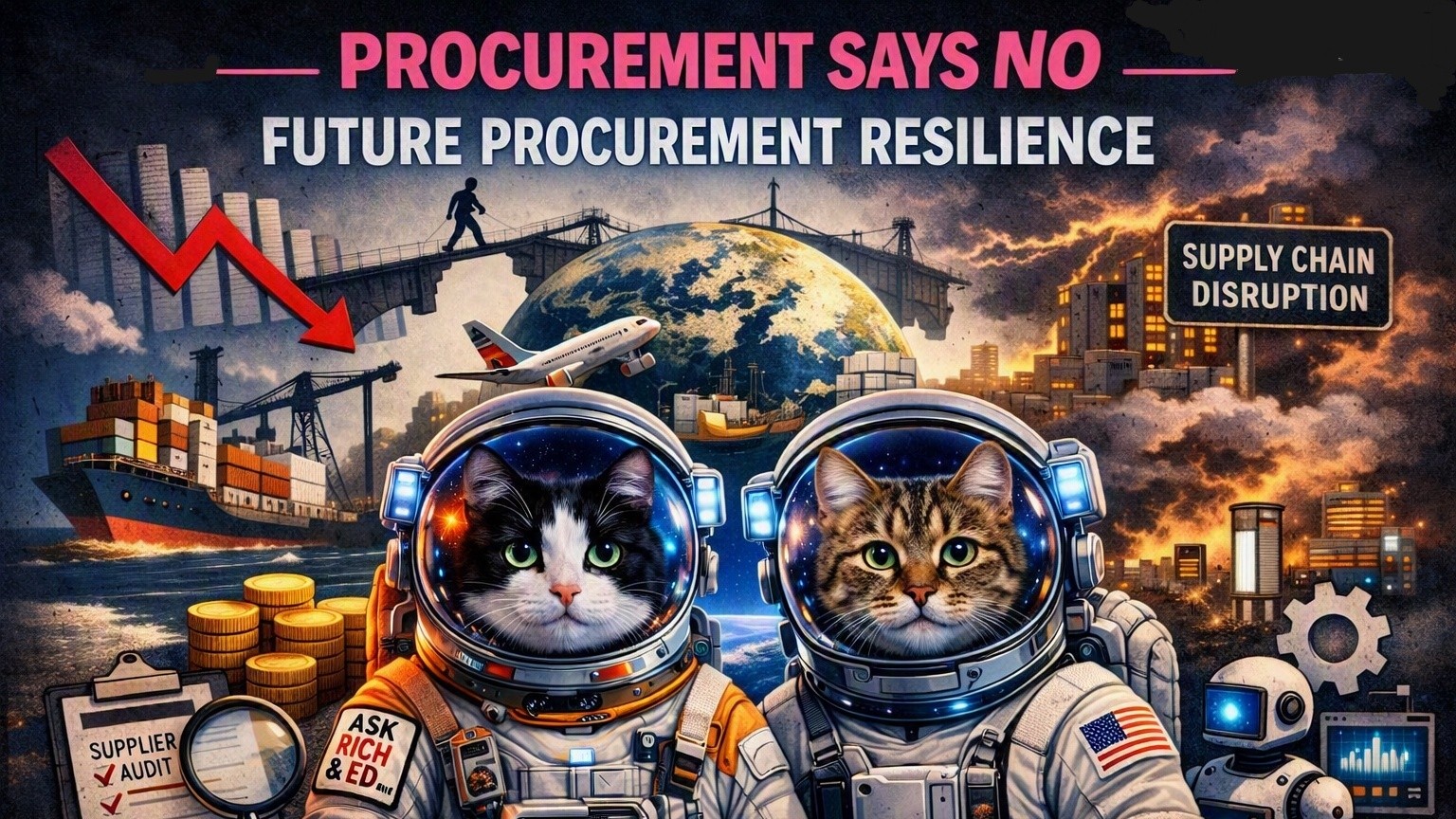
10 SEP 2026 · It feels like a dream, or maybe a nightmare - but times are uncertain right now — and uncertainty is no longer a temporary condition.
It's ok though because Procurement feels it first.
Uncertainty is structural. Inflation, geopolitical tension, supply chain fragility, regulatory churn, and sudden supplier failure have shifted procurement’s centre of gravity. Luckily, procurement people love a risk register. And we also love a stakeholder who asks us to find a cheaper supplier by Friday.
Procurement says no. But politely. With a spreadsheet.
The future of procurement (especially in uncertain times) looks less like “running tenders” and more like running resilience: protecting continuity of supply, managing inflation-driven cost pressure, and actively reducing risk across a wider slice of the supplier base — not just the top 20 “strategic” suppliers.
You can see that shift clearly in the way leaders keep coming back to the same three priorities:
- Reduce third‑party cost
- Reduce the cost-to-procure
- Manage risk better
Everything else is noise.
Here’s what that future shape looks like — with real examples to bring it to life.
1. A tougher, more commercial core (cost + cash)
Inflation keeps pushing procurement into rapid value-for-money work, often crowding out “nice-to-haves”. The winners won’t just negotiate price; they’ll work total cost, demand management, specs, and should-cost.
What this looks like in practice:
- Total cost: A packaging supplier proposes a 9% uplift. Instead of arguing unit price, procurement models the full cost stack — logistics, minimum order quantities, waste, storage — and finds a 14% saving by changing pallet configuration and reducing over-spec materials.
- Demand management: A business unit wants to renew 300 software licences “just in case”. Procurement says: “You used 147 last year”, challenges usage data and renews only 180, saving £120k without reducing capability.
- Specification discipline: Engineering requests a premium-grade component with a 12-week lead time. Procurement: “You need the mid-grade component. You want the premium one.” Engineering: “But it’s nicer.” Procurement: “So is a Bentley. We’re buying a van.” Procurement proves the mid-grade version meets requirements and cuts cost by 22% while improving continuity.
- Should-cost: A supplier claims raw material inflation justifies a price increase. Procurement uses should-cost modelling to show the real impact is 3.4%, not 11%. The uplift disappears, but thank the supplier for their creativity.
Procurement Says No to soft justifications and “market conditions” that only exist in supplier PowerPoints.
Procurement Says Yes to commercial rigour.
2. Risk moves from a register to an operating discipline
Risk used to be a spreadsheet updated once a quarter. Now it’s a daily sport.
With “continuous shock” conditions — geopolitics, logistics disruption, supplier failure — procurement can’t treat risk as a static document. It becomes a daily operating rhythm.
What this looks like in practice:
- Dual sourcing: Procurement spots early signs of supplier distress (late deliveries, CFO resigns, LinkedIn posts get weird). Secondary supplier activated within 10 days. Production saved. Business thinks procurement is psychic.
- Continuity strategies: A critical chemical has a volatile global supply. Procurement builds a 45‑day buffer stock and negotiates a flexible call-off contract, stabilising production during a regional shutdown. Operations sleep better.
- Switching mechanisms: A logistics provider misses two consecutive KPIs. Procurement triggers a pre-agreed switch clause and transitions 40% of volume to an alternate carrier within 72 hours. Stakeholders ask: “Can we do this for everything?” Procurement Says No.
- Faster escalation playbooks: A regulatory change impacts a key supplier’s certification. Procurement uses a predefined escalation path — legal, compliance, technical — and resolves the issue in 5 days instead of 5 weeks. Supplier panics. Procurement does not.
Risk stops being theoretical. It becomes operational.
Procurement Says No to “we’ll review this next quarter”.
3. Supplier Management expands beyond classic SRM
Classic SRM focuses on the top 20 suppliers — the ones with glossy quarterly business reviews and branded cupcakes.
But the supplier that breaks your continuity is usually the tiny one nobody has spoken to since onboarding.
More focus on visibility, onboarding, compliance, and performance across the whole supply base, because a small unknown supplier can still break your supply chain. Hey, maybe take a look at Kodiak Hub!
What this looks like in practice:
- Onboarding discipline: A small subcontractor is onboarded without proper insurance checks. Procurement’s new onboarding workflow catches the gap before work begins, avoiding a £400k liability exposure. Finance sends a thank-you email. Procurement frames it.
- Compliance visibility: A long-tail supplier fails to meet new sustainability reporting rules. Procurement spots it early through automated compliance dashboards and replaces them before audit season. Sustainability team calls procurement “heroes”. Procurement pretends not to enjoy it.
- Performance monitoring: A niche supplier providing a critical component starts missing delivery windows. Procurement’s expanded monitoring flags the trend before it becomes a continuity issue. Operations assume procurement has installed cameras. Procurement Says No comment.
- Whole-base governance: Instead of quarterly reviews with the top 20 suppliers, procurement runs monthly risk scans across all 600 suppliers — identifying issues where nobody was previously looking. Business shocked. Procurement not shocked.
Procurement Says No to blind spots.
4. Agile sourcing models (less single-source fragility)
Uncertainty punishes rigidity. Expect more modular contracting, faster events, scenario-based awards, and regionalised supply options — especially where tariffs and trade rules can change quickly.
What this looks like in practice:
- Modular contracting: Instead of a single 5‑year IT contract, procurement breaks it into modules (hardware, support, cloud services) so each can be switched independently when markets shift. Stakeholders cheer.
- Faster events: A sudden tariff change hits a key category. Procurement runs a rapid 10‑day sourcing sprint and shifts 30% of volume to a tariff-neutral region. Finance calls procurement “agile”. Procurement blushes.
- Scenario-based awards: Procurement awards a contract with three pre-priced scenarios: stable market, inflationary market, and disrupted market — enabling automatic adjustment. No renegotiation needed. Supplier tries to renegotiate anyway. Procurement Says No.
- Regionalised supply: A global supplier faces port congestion. Procurement activates regional suppliers to maintain continuity and reduce lead times by 40%. Operations ask why this wasn’t done earlier. Procurement stares into the middle distance.
Procurement Says No to brittle supply chains.
5. Digital/AI grows — but slower than the hype
AI will creep into transactional work, analytics, and decision support — but transformation takes time, budgets, and clean data.
What this looks like in practice:
- Transactional automation: 60% of POs auto-generate from approved requisitions, freeing procurement capacity for commercial work. Someone suggests using that time for “more meetings”. Great.
- Analytics: AI flags a supplier whose delivery performance has declined 8% over three months — before the business notices. Supplier wonders how procurement knew. Procurement smiles mysteriously.
- Decision support: A sourcing bot drafts the first version of an RFP, saving two days of manual work. Procurement edits it heavily. Bot apologises. Procurement accepts. It's the AI 80:20 rule.
- Data reality: Procurement wants predictive risk modelling, but data quality delays rollout by six months. The future arrives — but incrementally, you know, one day at a time.
Procurement Says No to hype. Procurement Says Yes to useful.
Net-net: The future procurement function
The future procurement function is:
- Leaner
- More data-enabled
- More risk-forward
- More commercially disciplined
- More embedded in business decisions
Uncertainty turns procurement from “savings police” into a business continuity and value engine — the function that keeps the organisation running when everything else is wobbling.
Procurement Says No. To fragility. To surprises. To complacency. To reactive behaviour.
The future belongs to the resilient. Your Procurement team are heroes.
And then we woke up.
www.procurementsaysno.com
Transcribed
1 SEP 2026 · In episode 47 of your favourite procurement-flavoured podcast, Rich and Ed bring you much news from the supply chain front line and beyond:
- Another dead rock star
- No CIPS news but plenty of Avios points
- Coupa's new CEO - it's not Roy Batty
- Kimberley Clark's new fibres
- Panama canal runs out of water - shock
- Gartner's AI ROI report
- BCG's Generative AI report
- Ford and GM's opposing views of China
- EU to buy from EU - shock
- Romanian vaccine whiplash
- New procurement software that's as cheap as crisps
Plus more of your questions on Ask Rich and Ed:
- Culture fit in job interviews
- Stakeholders giving work to their favourite suppliers without a PO - shock
- Are fake RFPs ever a good idea?
- Should we buy all of our oil and gas via the Strait of Hormuz?
Plus Ed becomes a mentor.
Plus plus Rich & Ed become Marxists.
Plus plus plus more on our wonderful "Ask Rich and Ed bot" AI companion app - which will answer all of your questions with genius and brilliance. We couldn't believe it! You won't either - so click the link below to be amazed...
https://mentaraiq.com/share/chatbot/0e874f81-612c-46e5-8c7d-b1a8fc7ee544
Procurement Says No is now sponsored by Kodiak Hub - The SRM suite that makes you super smart. Check you out with your fancy plaid suit. www.KodiakHub.com Become a supporter of this podcast: https://www.spreaker.com/podcast/procurement-says-no--5886102/support.
Transcribed
31 AUG 2026 · How to deal with a cold caller. Hint - don't!
Another video which we said we'd never do. Except this is audio only.
They're on TikTok and YouTube (shorts) in full glorious video.
Now powered by www.KodiakHub.com. The smart SRM suite-spot. Become a supporter of this podcast: https://www.spreaker.com/podcast/procurement-says-no--5886102/support.
Join “Procurement Says No” Supporters Club
Start supporting this podcast and become part of their community.
The thoughts of two CIPS award winning procurement gods who want to share our love of procurement with newbies, oldies and the procurious. Generally we'll be talking nonsense about all...
show more
The thoughts of two CIPS award winning procurement gods who want to share our love of procurement with newbies, oldies and the procurious. Generally we'll be talking nonsense about all things procurement, with the occasional nugget of priceless insight.
All views are our own - we're not affiliated in any way to anybody or anything!
Er, except Kodiak Hub...who are sponsoring our shows. How smart of them.
show less
All views are our own - we're not affiliated in any way to anybody or anything!
Er, except Kodiak Hub...who are sponsoring our shows. How smart of them.
Information
| Author | Richard Beattie / Ed Cross |
| Organization | Richard Beattie |
| Categories | Management , Business , Comedy |
| Website | www.procurementsaysno.com |
| richardjbeattie@msn.com |

Copyright 2026 - Spreaker Inc. an iHeartMedia Company
