WPS Procedure Guide: Write a Welding Procedure Spec
Nov 12, 2026 ·
8m 3s
Download and listen anywhere
Download your favorite episodes and enjoy them, wherever you are! Sign up or log in now to access offline listening.
Description
Every load-bearing structural beam, cross-country hydrocarbon pipeline, and high-pressure boiler relies on a Welding Procedure Specification (WPS) to translate engineering metallurgy into repeatable shop and field execution. Far beyond mere...
show more
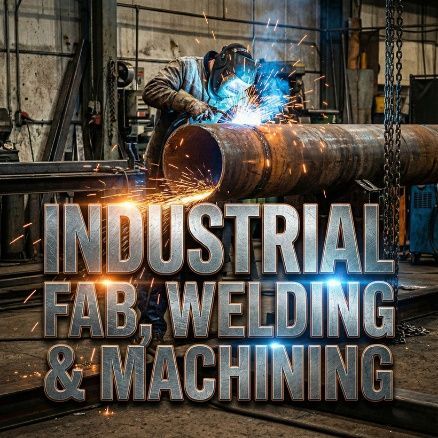
Every load-bearing structural beam, cross-country hydrocarbon pipeline, and high-pressure boiler relies on a Welding Procedure Specification (WPS) to translate engineering metallurgy into repeatable shop and field execution. Far beyond mere administrative paperwork, a compliant WPS operates alongside the Procedure Qualification Record (PQR) and Welder Performance Qualification (WPQ) as an integrated quality-assurance triad that prevents catastrophic structural failure and satisfies regulatory audits.On this episode of Industrial Fab, Welding & Machining, the fabrication and engineering specialists at LTJ Industrial Services break down how to construct a compliant WPS from the ground up, compare major governing code jurisdictions, and identify the documentation errors that invalidate welding procedures.Technical Comparison: Governing Welding Codes & Qualification Pathways
Read more
Learn more about LTJ Industrial Services at www.ltjindustrial.com/
show less
- Code Jurisdiction & Application Scope:
- AWS D1.1 (Structural Welding Code – Steel): Governs buildings, bridges, and heavy structural frames; permits prequalified WPSs without destructive coupon testing only when strictly matching pre-approved ASTM base metals, joint designs, and parameter envelopes.
- ASME Section IX (Boiler and Pressure Vessel Code): Governs pressure-retaining equipment, boilers, and process piping; requires a destructive PQR qualification test for every custom WPS with zero prequalified exceptions.
- API 1104 (Welding of Pipelines and Related Facilities): Governs cross-country transmission pipelines with specialized destructive tensile, nick-break, and root/face bend validation criteria.
- The Three-Legged Qualification Triad:
- Welding Procedure Specification (WPS): The operational recipe defining permitted operating ranges for base metal P-numbers/groups, filler metal classifications, shielding gas mixtures, amperage, voltage, wire-feed/travel speeds, thermal controls, and bead techniques (stringer vs. weave).
- Procedure Qualification Record (PQR): The empirical proof logging actual measured values recorded during test-coupon welding, paired with certified laboratory destructive test results.
- Welder Performance Qualification (WPQ): The operator certification verifying that an individual welder possesses the manual dexterity to execute the WPS across specific joint positions and thickness bounds.
- Documentation & Parameter Integrity:
- Invalidated / Audit-Vulnerable Procedures: Lock parameters to rigid single numbers rather than code-permitted ranges, copy theoretical target numbers onto the WPS instead of actual PQR test readings, or rely on superseded code editions.
- Audit-Ready Controlled Libraries: Specify practical operating ranges backed by actual PQR telemetry, maintain current code revisions, and link every active procedure directly to specific asset classes and welder continuity logs.
- Confirm Governing Code & Active Edition First: Identify whether project specifications fall under AWS D1.1, ASME Section IX, or API 1104 before drafting procedures; maintain completely separate WPSs whenever a facility operates under multiple codes.
- Draft Practical Operating Ranges: Specify allowable amperage, voltage, and travel-speed windows rather than single point values so welders can adapt to real-world fit-up and position shifts without violating the procedure.
- Record Actual Coupon Values on the PQR: Log exact measured electrical and thermal inputs during qualification welding, ensuring the resulting WPS never drifts outside the bounds validated by destructive testing.
- Enforce Preheat & Interpass Thermal Telemetry: Monitor minimum preheat and maximum interpass temperatures using calibrated pyrometers or temperature-indicating crayons—especially on thick heavy-wall sections and cold-weather field repairs.
- Audit Contractor Credentials Pre-Mobilization: Before outsourcing fabrication or field repairs, run a pre-job checklist verifying WPS/PQR cross-reference numbers, governing code editions, engineering sign-offs, and active welder continuity records.
Read more
Learn more about LTJ Industrial Services at www.ltjindustrial.com/
Information
| Author | Don Markland |
| Organization | Don Markland |
| Website | - |
| Tags |

Copyright 2026 - Spreaker Inc. an iHeartMedia Company

Comments