One PLC, Multiple Security Lifecycles: The SIMATIC S7-1500 Linux Subsystem Problem
Sep 21, 2026 ·
1h 15m 16s
Download and listen anywhere
Download your favorite episodes and enjoy them, wherever you are! Sign up or log in now to access offline listening.
Description
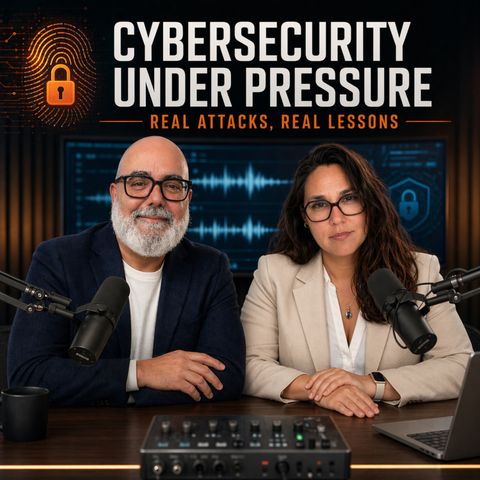
An industrial asset may appear as a single box in an inventory, but that does not mean everything inside it follows the same cybersecurity lifecycle. In this episode of Cybersecurity...
show more
An industrial asset may appear as a single box in an inventory, but that does not mean everything inside it follows the same cybersecurity lifecycle.
In this episode of Cybersecurity Under Pressure: Real Attacks, Real Lessons, we examine vulnerabilities affecting the additional GNU/Linux subsystem of the Siemens SIMATIC S7-1500 CPU 1518(F)-4 PN/DP MFP and use them to challenge one of the most persistent simplifications in OT asset management: the assumption that one physical device represents one software stack, one vulnerability profile and one maintenance lifecycle.
The Technical Breakdown explores what changes when a traditional PLC platform also contains a general-purpose Linux environment. The control functionality and the Linux subsystem may coexist inside the same industrial device, but their security characteristics are very different. Linux brings its own kernel, libraries, packages and vulnerability stream, creating dependencies and remediation requirements that may evolve independently from the automation functions operators normally associate with the PLC.
The Operational Decisions examine why this matters in a real plant. An asset inventory may tell you that a particular S7-1500 is installed, while still failing to identify the version and exposure of the subsystem running inside it. Vulnerability management therefore has to move beyond device-level identification toward component-level understanding. Teams need to know which software environments are present, who owns their maintenance, which updates apply to each layer and whether remediation can be performed without affecting deterministic control, validated configurations or production availability.
In The Pressure Test, you are responsible for securing a factory where PLCs control high-consequence physical processes. A vulnerability disclosure affects the Linux environment inside devices that production teams regard simply as PLCs. Stopping the process is expensive, patching introduces operational uncertainty and leaving the subsystem untouched preserves known exposure. You must determine which lifecycle takes precedence, how to validate the update and what evidence is necessary before returning the system to normal operation.
The key lesson is that modern industrial assets increasingly contain several security domains inside the same physical product. Firmware, operating systems, applications, containers and control logic may each evolve at different speeds and may require different vulnerability monitoring, patching and support strategies. Asset management therefore has to represent not only what the device is, but also what is running inside it and how each component is maintained throughout its life.
Because in modern OT, one asset no longer necessarily means one cybersecurity lifecycle.
Thanks for listening to Cybersecurity Under Pressure. Follow the show for more real attacks, technical breakdowns and practical lessons for cybersecurity leaders.
Explore all episodes and resources:https://cybersecurityunderpressure.com/episodes
show less
In this episode of Cybersecurity Under Pressure: Real Attacks, Real Lessons, we examine vulnerabilities affecting the additional GNU/Linux subsystem of the Siemens SIMATIC S7-1500 CPU 1518(F)-4 PN/DP MFP and use them to challenge one of the most persistent simplifications in OT asset management: the assumption that one physical device represents one software stack, one vulnerability profile and one maintenance lifecycle.
The Technical Breakdown explores what changes when a traditional PLC platform also contains a general-purpose Linux environment. The control functionality and the Linux subsystem may coexist inside the same industrial device, but their security characteristics are very different. Linux brings its own kernel, libraries, packages and vulnerability stream, creating dependencies and remediation requirements that may evolve independently from the automation functions operators normally associate with the PLC.
The Operational Decisions examine why this matters in a real plant. An asset inventory may tell you that a particular S7-1500 is installed, while still failing to identify the version and exposure of the subsystem running inside it. Vulnerability management therefore has to move beyond device-level identification toward component-level understanding. Teams need to know which software environments are present, who owns their maintenance, which updates apply to each layer and whether remediation can be performed without affecting deterministic control, validated configurations or production availability.
In The Pressure Test, you are responsible for securing a factory where PLCs control high-consequence physical processes. A vulnerability disclosure affects the Linux environment inside devices that production teams regard simply as PLCs. Stopping the process is expensive, patching introduces operational uncertainty and leaving the subsystem untouched preserves known exposure. You must determine which lifecycle takes precedence, how to validate the update and what evidence is necessary before returning the system to normal operation.
The key lesson is that modern industrial assets increasingly contain several security domains inside the same physical product. Firmware, operating systems, applications, containers and control logic may each evolve at different speeds and may require different vulnerability monitoring, patching and support strategies. Asset management therefore has to represent not only what the device is, but also what is running inside it and how each component is maintained throughout its life.
Because in modern OT, one asset no longer necessarily means one cybersecurity lifecycle.
Thanks for listening to Cybersecurity Under Pressure. Follow the show for more real attacks, technical breakdowns and practical lessons for cybersecurity leaders.
Explore all episodes and resources:https://cybersecurityunderpressure.com/episodes
Information
| Author | Antonio Gonzalez |
| Organization | Antonio Gonzalez |
| Website | - |
| Tags |
-
|

Copyright 2026 - Spreaker Inc. an iHeartMedia Company

Comments