AI-generated content
Kabbalah.
May 9, 2026 ·
2m 59s
Download and listen anywhere
Download your favorite episodes and enjoy them, wherever you are! Sign up or log in now to access offline listening.
Description
Kabbalah. Kabbalah is an esoteric tradition within Judaism comprising theosophical mysticism and contemplative practices that interpret the Torah symbolically to understand the divine structure and creation. It emerged historically in...
show more
Kabbalah.
Kabbalah is an esoteric tradition within Judaism comprising theosophical mysticism and contemplative practices that interpret the Torah symbolically to understand the divine structure and creation. It emerged historically in the 12th century in Provence, southern France, and spread to Spain by the early 13th century, marking a distinct development from earlier forms of Jewish mysticism such as Merkabah traditions. Drawing on influences including Neoplatonism and residual Gnostic elements reinterpreted within Jewish monotheism, Kabbalah posits a dynamic inner life of the Godhead while rejecting dualistic cosmologies.
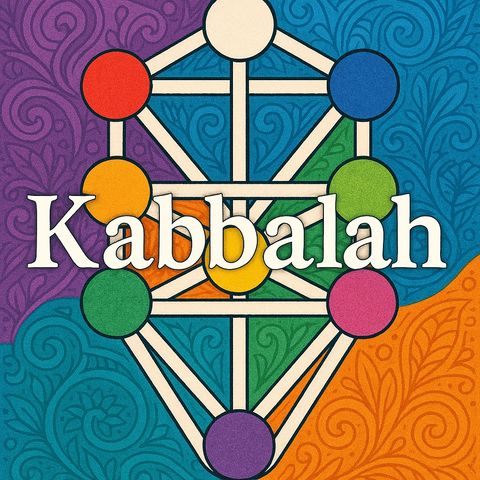
Central to Kabbalah are the concepts of Ein Sof, the infinite and unknowable divine essence, and the ten sefirot, emanations or potencies through which divine influence flows into the finite world, often diagrammed as the Tree of Life. These sefirot—enumerated as Keter (Crown), Chokhmah (Wisdom), Binah (Understanding), Chesed (Kindness), Gevurah (Severity), Tiferet (Beauty), Netzach (Eternity), Hod (Splendor), Yesod (Foundation), and Malkhut (Kingship)—represent attributes of God that interrelate in processes of emanation, judgment, and redemption, with human actions capable of affecting cosmic harmony. Practices emphasize kawwanah (intended devotion) in prayer and meditation on divine names to align the soul with these structures, traditionally restricted to mature scholars versed in Torah and Talmud to avoid misinterpretation or spiritual peril.
The foundational text, the Zohar ("Book of Splendor"), a Aramaic commentary on the Torah compiled in late 13th-century Castile, systematizes these ideas through narrative and homiletic forms, though pseudepigraphically attributed to the 2nd-century Rabbi Shimon bar Yochai. Scholarly analysis, pioneered by Gershom Scholem, establishes its authorship primarily to Moses de León based on textual, linguistic, and historical evidence, refuting claims of antiquity despite traditional reverence within Jewish communities. Earlier works like the Bahir laid groundwork with gnostic motifs, but Kabbalah's full theosophical framework crystallized in circles around figures such as Isaac the Blind.
Kabbalah has faced controversies over textual authenticity and doctrinal innovation, with critics like 17th-century rabbi Leon Modena decrying it as a medieval fabrication incompatible with rationalist Judaism, while proponents integrated it into mainstream observance post-expulsion from Spain. Empirical historiography reveals no direct continuity to biblical or talmudic esotericism, but rather a synthetic response to philosophical challenges, influencing later Hasidism and Lurianic innovations without empirical validation of supernatural claims.
This episode includes AI-generated content.
show less
Kabbalah is an esoteric tradition within Judaism comprising theosophical mysticism and contemplative practices that interpret the Torah symbolically to understand the divine structure and creation. It emerged historically in the 12th century in Provence, southern France, and spread to Spain by the early 13th century, marking a distinct development from earlier forms of Jewish mysticism such as Merkabah traditions. Drawing on influences including Neoplatonism and residual Gnostic elements reinterpreted within Jewish monotheism, Kabbalah posits a dynamic inner life of the Godhead while rejecting dualistic cosmologies.
Central to Kabbalah are the concepts of Ein Sof, the infinite and unknowable divine essence, and the ten sefirot, emanations or potencies through which divine influence flows into the finite world, often diagrammed as the Tree of Life. These sefirot—enumerated as Keter (Crown), Chokhmah (Wisdom), Binah (Understanding), Chesed (Kindness), Gevurah (Severity), Tiferet (Beauty), Netzach (Eternity), Hod (Splendor), Yesod (Foundation), and Malkhut (Kingship)—represent attributes of God that interrelate in processes of emanation, judgment, and redemption, with human actions capable of affecting cosmic harmony. Practices emphasize kawwanah (intended devotion) in prayer and meditation on divine names to align the soul with these structures, traditionally restricted to mature scholars versed in Torah and Talmud to avoid misinterpretation or spiritual peril.
The foundational text, the Zohar ("Book of Splendor"), a Aramaic commentary on the Torah compiled in late 13th-century Castile, systematizes these ideas through narrative and homiletic forms, though pseudepigraphically attributed to the 2nd-century Rabbi Shimon bar Yochai. Scholarly analysis, pioneered by Gershom Scholem, establishes its authorship primarily to Moses de León based on textual, linguistic, and historical evidence, refuting claims of antiquity despite traditional reverence within Jewish communities. Earlier works like the Bahir laid groundwork with gnostic motifs, but Kabbalah's full theosophical framework crystallized in circles around figures such as Isaac the Blind.
Kabbalah has faced controversies over textual authenticity and doctrinal innovation, with critics like 17th-century rabbi Leon Modena decrying it as a medieval fabrication incompatible with rationalist Judaism, while proponents integrated it into mainstream observance post-expulsion from Spain. Empirical historiography reveals no direct continuity to biblical or talmudic esotericism, but rather a synthetic response to philosophical challenges, influencing later Hasidism and Lurianic innovations without empirical validation of supernatural claims.
This episode includes AI-generated content.
Information
| Author | Popular Culture and Religion. |
| Organization | Popular Culture and Religion. |
| Website | - |
| Tags |
-
|

Copyright 2026 - Spreaker Inc. an iHeartMedia Company

Comments