Dry Microbursts
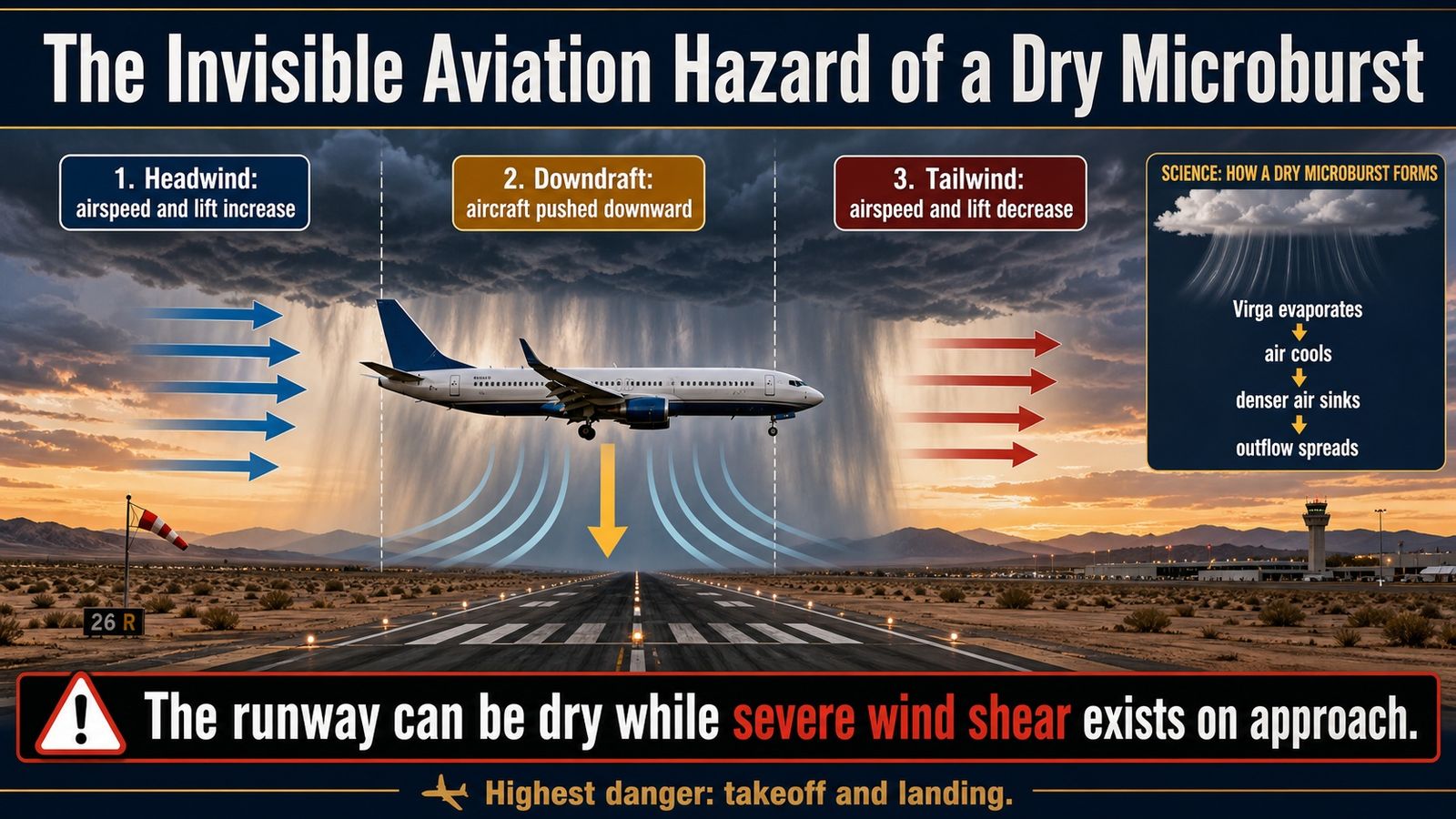
THE INVISIBLE AVIATION HAZARD OF A DRY MICROBURST
In the Desert Southwest, thunderstorms do not always produce measurable rainfall at the surface. Rain can fall from a cloud and evaporate before reaching the ground, a phenomenon known as virga.
Even without rain reaching the surface, virga can create powerful and dangerous outflow winds. As precipitation falls through very dry air, evaporation cools the surrounding air. The cooled air becomes denser than the warmer air around it and accelerates downward. This process, called evaporative cooling, is the primary mechanism behind many dry microbursts. [web:52]
When the descending air reaches the ground, it spreads outward in all directions. That outward surge of wind is called a microburst or downburst. A dry microburst can occur with little or no rainfall at the surface, even while producing strong and sudden wind gusts. [web:52]
For an aircraft approaching a runway, the wind pattern can be especially hazardous:
1. The airplane may first encounter a strong headwind, increasing airspeed and lift.
2. It may then fly into the central downdraft, which pushes the aircraft downward.
3. It may next enter the opposite side of the outflow, where the headwind rapidly changes into a tailwind.
4. The tailwind reduces airspeed and lift at the same time the aircraft may still be descending.
This headwind-to-downdraft-to-tailwind sequence can occur very close to the ground and in a short period of time. The FAA warns that microburst wind shear is especially hazardous within 1,000 feet of the ground during takeoff, approach, and landing. [web:63]
That is why wind-shear alerts are treated as immediate aviation hazards. Flight crews are trained to follow their aircraft’s wind-shear escape procedure rather than attempting minor corrections to remain on the normal glide path.
The key danger is that a dry microburst may not be visually obvious at the runway. Pavement may remain dry, and little or no rain may be falling, while severe wind shear exists in the approach corridor. [web:52][web:63]
In the Desert Southwest, thunderstorms do not always produce measurable rainfall at the surface. Rain can fall from a cloud and evaporate before reaching the ground, a phenomenon known as virga.
Even without rain reaching the surface, virga can create powerful and dangerous outflow winds. As precipitation falls through very dry air, evaporation cools the surrounding air. The cooled air becomes denser than the warmer air around it and accelerates downward. This process, called evaporative cooling, is the primary mechanism behind many dry microbursts. [web:52]
When the descending air reaches the ground, it spreads outward in all directions. That outward surge of wind is called a microburst or downburst. A dry microburst can occur with little or no rainfall at the surface, even while producing strong and sudden wind gusts. [web:52]
For an aircraft approaching a runway, the wind pattern can be especially hazardous:
1. The airplane may first encounter a strong headwind, increasing airspeed and lift.
2. It may then fly into the central downdraft, which pushes the aircraft downward.
3. It may next enter the opposite side of the outflow, where the headwind rapidly changes into a tailwind.
4. The tailwind reduces airspeed and lift at the same time the aircraft may still be descending.
This headwind-to-downdraft-to-tailwind sequence can occur very close to the ground and in a short period of time. The FAA warns that microburst wind shear is especially hazardous within 1,000 feet of the ground during takeoff, approach, and landing. [web:63]
That is why wind-shear alerts are treated as immediate aviation hazards. Flight crews are trained to follow their aircraft’s wind-shear escape procedure rather than attempting minor corrections to remain on the normal glide path.
The key danger is that a dry microburst may not be visually obvious at the runway. Pavement may remain dry, and little or no rain may be falling, while severe wind shear exists in the approach corridor. [web:52][web:63]
Information
| Author | Simcha |
| Organization | Kol Simcha Productions |
| Website | - |

Copyright 2026 - Spreaker Inc. an iHeartMedia Company

Comments