Transcribed
Course 37 - Building Web Apps with Ruby On Rails | Episode 10: Setup, Parallelization, and Dynamic Data Seeding
Jun 23, 2026 ·
18m 46s
Download and listen anywhere
Download your favorite episodes and enjoy them, wherever you are! Sign up or log in now to access offline listening.
Course 37 - Building Web Apps with Ruby On Rails | Episode 10: Setup, Parallelization, and Dynamic Data Seeding
This automatic transcript is brought to you by
Sounder.AI
This is an automatically generated transcript. Please note that complete accuracy is not guaranteed.
Description
In this lesson, you’ll learn about: setting up a robust testing environment in Ruby on Rails using isolated databases, parallel execution, and dynamic test data generation1. Project Overview (Testing Context)Using...
show more
In this lesson, you’ll learn about: setting up a robust testing environment in Ruby on Rails using isolated databases, parallel execution, and dynamic test data generation1. Project Overview (Testing Context)Using Ruby on Rails:🔹 Application features:
Testing must reflect real-world usage, especially for interactive apps2. Isolated Test Environment🔹 Principle:
Isolation guarantees safe and consistent testing cycles3. Preparing the Test Database🔹 Command:rails db:test:prepare 🔹 Purpose:
A clean database ensures reliable test results4. Parallel Testing🔹 Concept:
Parallelization is critical for modern, large-scale applications5. Fixtures vs FactoriesFixtures🔹 Characteristics:
Factories provide flexibility and realism in testing6. Generating Realistic Test Data🔹 Example:FactoryBot.create(:user) 🔹 With Faker:
Realistic data helps uncover edge cases and hidden bugs7. Stress Testing & Edge Cases🔹 Goal:
Good test data exposes weaknesses before production8. Preparing for Unit Testing🔹 Foundation:
A strong environment is required before writing meaningful testsKey Takeaways
👉 Speed up test execution with parallelization
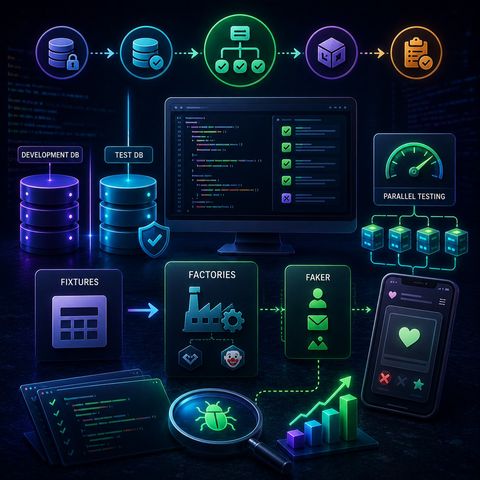
👉 Simulate real-world conditions using dynamic dataMental ModelIsolate environment → prepare database → generate realistic data → run tests in parallel → validate system reliability
You can listen and download our episodes for free on more than 10 different platforms:
https://linktr.ee/cybercode_academy
show less
- User profiles
- Swipe functionality
- Mobile-first design
- Powered by Vue.js
Testing must reflect real-world usage, especially for interactive apps2. Isolated Test Environment🔹 Principle:
- Keep test data separate from development data
- Prevent data corruption
- Ensure repeatable test runs
- Dedicated test database
Isolation guarantees safe and consistent testing cycles3. Preparing the Test Database🔹 Command:rails db:test:prepare 🔹 Purpose:
- Sync schema with development
- Reset test database state
A clean database ensures reliable test results4. Parallel Testing🔹 Concept:
- Run tests simultaneously using multiple workers
- Faster execution time
- Better scalability for large test suites
- Multiple processes testing different parts of the app
Parallelization is critical for modern, large-scale applications5. Fixtures vs FactoriesFixtures🔹 Characteristics:
- Static data
- Predefined records
- Not flexible
- Hard to scale
- FactoryBot
- Faker
- Dynamic data generation
- Realistic test scenarios
- Easy customization
Factories provide flexibility and realism in testing6. Generating Realistic Test Data🔹 Example:FactoryBot.create(:user) 🔹 With Faker:
- Random names
- Emails
- Profile data
Realistic data helps uncover edge cases and hidden bugs7. Stress Testing & Edge Cases🔹 Goal:
- Simulate real-world usage
- Generate large datasets
- Test unusual inputs
Good test data exposes weaknesses before production8. Preparing for Unit Testing🔹 Foundation:
- Clean database
- Dynamic data
- Fast execution
- Write low-level unit tests
A strong environment is required before writing meaningful testsKey Takeaways
- Separate test and development databases
- Use rails db:test:prepare for consistency
- Parallel testing improves speed
- Factories are superior to fixtures for scalability
- Realistic data reveals hidden issues
👉 Speed up test execution with parallelization
👉 Simulate real-world conditions using dynamic dataMental ModelIsolate environment → prepare database → generate realistic data → run tests in parallel → validate system reliability
You can listen and download our episodes for free on more than 10 different platforms:
https://linktr.ee/cybercode_academy
Information

Copyright 2026 - Spreaker Inc. an iHeartMedia Company

Comments