Application Chains vs. Dapps
Feb 27, 2024 ·
3m 18s
Download and listen anywhere
Download your favorite episodes and enjoy them, wherever you are! Sign up or log in now to access offline listening.
Description
Today, we'll cover four key ideas about Application Chains and Decentralized Applications (DApps). First, we'll discuss what makes Application Chains different, focusing on their unique characteristics. Then, we'll compare the...
show more
Today, we'll cover four key ideas about Application Chains and Decentralized Applications (DApps). First, we'll discuss what makes Application Chains different, focusing on their unique characteristics. Then, we'll compare the security implications of running a DApp versus an Application Chain. After that, we'll dive into the performance trade-offs between these two approaches. Finally, we'll explore the economic models and governance involved with Application Chains and DApps.
Here are the key principles from the podcast:
- When evaluating the need for performance versus security, an Application Chain offers dedicated infrastructure which might be more performant but requires meticulous security considerations, while a DApp relies on the underlying blockchain's security, reducing the risk to just the DApp's code.
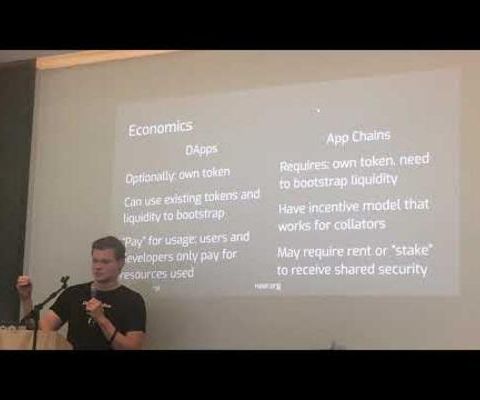
- Unlike DApps, which pay only for the computational resources they use, running an Application Chain often entails paying for the full capacity, potentially resulting in overpayment if the chain is underutilized.
- For those who prioritize independent governance and specific infrastructure requirements, an Application Chain might be favorable, but this comes with the need for functional governance from the start.
- Starting a DApp provides the agility of quick deployment and iterative development, a stark contrast to the slower, more coordinated launch process of an Application Chain.
Here's a story that illustrates an important point: Imagine you've built an Application Chain, and it's now popular like CryptoKitties once was, to the extent that it requires a full shard's performance. With dynamic sharding, a system like NEAR Protocol can dynamically allocate a full shard to support your application’s needs, providing unparalleled performance for high-demand apps.
Definitions:
- Application Chain: A separate blockchain created for a specific application, often requiring its own security and governance.
- DApp: A decentralized application that runs on an existing blockchain, leveraging the blockchain's security and infrastructure.
Here are a few memorable quotes:
- "When you're building your own chain, you actually need to figure out your own crypto economics."
- "You get the full performance [with an application chain]; there's no other transactions happening, no limitations to what you do."
- "If you're running a DApp... the security risk that you have is just your app code."
Core Takeaway:
The dilemma faced is between choosing to build a dedicated Application Chain or a DApp that operates on an existing blockchain platform. Understanding this dichotomy is critical for developers aiming to optimize for performance, security, and economic efficiency. The consequence of not addressing this could result in misallocated resources, heightened security risks, or governance challenges.
The podcast presented a new perspective: Application Chains are more suited for applications that require high performance and specific infrastructure changes, while DApps allow for rapid deployment and are easier to secure. Opting for an Application Chain involves a greater commitment and understanding of blockchain mechanics, while DApps benefit from the stability and shared security of established blockchains.
Tags here: Application Chains, DApps, NEAR Protocol, blockchain security, smart contracts, dynamic sharding, governance
show less
Here are the key principles from the podcast:
- When evaluating the need for performance versus security, an Application Chain offers dedicated infrastructure which might be more performant but requires meticulous security considerations, while a DApp relies on the underlying blockchain's security, reducing the risk to just the DApp's code.
- Unlike DApps, which pay only for the computational resources they use, running an Application Chain often entails paying for the full capacity, potentially resulting in overpayment if the chain is underutilized.
- For those who prioritize independent governance and specific infrastructure requirements, an Application Chain might be favorable, but this comes with the need for functional governance from the start.
- Starting a DApp provides the agility of quick deployment and iterative development, a stark contrast to the slower, more coordinated launch process of an Application Chain.
Here's a story that illustrates an important point: Imagine you've built an Application Chain, and it's now popular like CryptoKitties once was, to the extent that it requires a full shard's performance. With dynamic sharding, a system like NEAR Protocol can dynamically allocate a full shard to support your application’s needs, providing unparalleled performance for high-demand apps.
Definitions:
- Application Chain: A separate blockchain created for a specific application, often requiring its own security and governance.
- DApp: A decentralized application that runs on an existing blockchain, leveraging the blockchain's security and infrastructure.
Here are a few memorable quotes:
- "When you're building your own chain, you actually need to figure out your own crypto economics."
- "You get the full performance [with an application chain]; there's no other transactions happening, no limitations to what you do."
- "If you're running a DApp... the security risk that you have is just your app code."
Core Takeaway:
The dilemma faced is between choosing to build a dedicated Application Chain or a DApp that operates on an existing blockchain platform. Understanding this dichotomy is critical for developers aiming to optimize for performance, security, and economic efficiency. The consequence of not addressing this could result in misallocated resources, heightened security risks, or governance challenges.
The podcast presented a new perspective: Application Chains are more suited for applications that require high performance and specific infrastructure changes, while DApps allow for rapid deployment and are easier to secure. Opting for an Application Chain involves a greater commitment and understanding of blockchain mechanics, while DApps benefit from the stability and shared security of established blockchains.
Tags here: Application Chains, DApps, NEAR Protocol, blockchain security, smart contracts, dynamic sharding, governance
Information
| Author | Higher Signal by Tim |
| Organization | Timothy Fong |
| Website | - |
| Tags |

Copyright 2026 - Spreaker Inc. an iHeartMedia Company

Comments